Jahrgang 12, Nr. 3, ISSN 2363-6513, Juni 2026
The photographs of the German Wehrmacht’s Propaganda Companies as sources on the events in occupied Poland 1939–1945
by Miriam Y. Arani
Originalquelle / Original Source:
Miriam Y. Arani: Die Fotografien der Propagandakompanien der deutschen Wehrmacht als Quellen zu den Ereignissen im besetzten Polen 1939–1945.
In: Zeitschrift für Ostmitteleuropa-Forschung (ZfO), Bd. 60, 2011, Heft 1, S. 1–49.
Erstveröffentlichung / Archivlink:
https://www.hsozkult.de/journal/id/zeitschriftenausgaben-6329
DOI / Volltext auf der Website der Zeitschrift:
https://doi.org/10.25627/20116019144
ZfO Online:
https://www.zfo-online.de/
Übersetzung aus dem Deutschen:
Gita Marta Yegane Arani.
Abstract
Photographs produced by the propaganda companies (Propagandakompanien, PK) of the German Wehrmacht have long shaped the visual memory of the Second World War. Often overlooked, however, is the fact that these images were created as instruments of psychological warfare. They served not only to glorify the German military as National Socialist war propaganda, but also to visually stigmatize, dehumanize, and discredit alleged or real “enemies” of the regime.
Research has shown that photographs produced by the propaganda companies were subject to systematic selection, censorship, and manipulation by both the Reich Ministry of Propaganda and the Wehrmacht High Command. This challenges the once widespread assumption that such images constituted a form of neutral or objective war reporting.
The propaganda companies operated on all fronts of the war, in occupied territories and within Germany itself. As visual records that closely followed the movements and activities of the German armed forces, the photographs produced in East Central Europe deserve particular attention. It was in these occupied regions – especially in Poland – that millions of civilians and soldiers lost their lives, including many victims of the Holocaust.
Focusing on the production, circulation, and historical context of propaganda photography in German-occupied Poland between 1939 and 1945, this article examines the ambivalent nature of these visual sources. On the one hand, the photographs reflect an intentional ideological iconography shaped by National Socialist propaganda; on the other, they remain important historical documents containing traces of the realities they sought to frame and control.
Tags: Propagandakompanien; Wehrmacht Photography; National Socialist Propaganda; Occupied Poland; Visual History; Holocaust Studies; Enemy Images; Second World War; Visual History; Holocaust Studies; Psychological Warfare
The photographs of the German Wehrmacht’s Propaganda Companies as sources on the events in occupied Poland 1939–1945
by Miriam Y. Arani
The photographs most frequently used to visually depict World War II in the press, in exhibitions, in academic and political publications, as well as in illustrated books, were produced by the Propaganda Companies [Propagandakompanien, PK] of the German Wehrmacht (Fig. 1) and were an integral part of the wartime propaganda of that era. A source-critical approach to photographs from World War II and German-occupied Europe remains the exception rather than the rule to this day, although these visual sources, too, require critical examination, analysis, and interpretation. [1] As was recently noted at a conference held by the Neuengamme Concentration Camp Memorial on images of National Socialist camps and ghettos, research on images produced under National Socialist rule still presents numerous gaps. The methodologically most important goal at present, to combine a careful critical analysis of pictorial sources with an examination of the aesthetic dimension and iconography, has so far only been rarely achieved. [2] The state of research specifically on photography under National Socialist rule does not differ significantly – particularly with regard to the relationship between empiricism and theory – from the German- and English-language state of research on the general history of photography, where empirically grounded, case-specific studies stand side by side, largely unmediated, with photographic theories that claim very broad applicability. [3] In the meantime, the source value of press photographs produced by the Propaganda Companies (PK) of the German Wehrmacht has become highly contested: on the one hand, it is being called into question more strongly [4]; on the other, it is being valued more highly than before in light of new perspectives – such as those related to urban and architectural history. [5] In contrast to the author’s monograph on the “Reichsgau Wartheland,” [6] which sought to typologically organize the various social uses of the medium of photography within an administrative unit of occupied Poland, the considerations presented here focus exclusively to the official government-directed and militarily organized visual reporting of the National Socialist state.

Fig. 1: German soldiers from a Propaganda Company in an open vehicle, Litzmannstadt (Łódź), 1941, Photographer: Zermin, PK 689 (BArch, Image 101I-133-0703-33/Zermin/CC-BY-SA)
—
Of the approximately three million photographic images produced by the PK, around 1.7 million have been preserved in various archives. The largest holdings are kept in the Federal Archives [Bundesarchiv] in the sub-collections Bild 101I (Army and Air Force), Bild 101II (Navy), and Bild 101III (Waffen-SS), as well as Bild 183 (Allgemeiner Deutscher Nachrichtendienst – Zentralbild). [7] In addition, there are the estates of individual PK photographers, such as that of Artur Grimm in the Image Archive of the Prussian Cultural Heritage Foundation. [8] The Propaganda Troops of the German Wehrmacht were deployed on all war fronts and in all occupied territories. To date, the PK photographs from the eastern theaters of war – where the genocidal dimension of National Socialism was most evident [9] and where not only military activity but also the loss of human life was greatest [10] – have not been systematically studied. Consequently, no monograph exists either on the approximately 25,000 PK photographs from occupied Poland or on those from other war and occupation zones in East-Central and Eastern Europe. The following section therefore summarizes research findings from the past decade on PK photographs, with a geographical focus on German-occupied Poland, in order to improve the conditions for their critical use as sources. At the same time, the aim is to substantiate the view that the visual message of PK photography cannot be understood in isolation from its context in which it was created. [11]
Various researchers have by now uncovered a complex network of administrative control processes governing the production and distribution of PK photographs, knowledge of which is indispensable for a more precise assessment of the source value of these visual mass sources of high transnational relevance. In addition to the question of what PK photographs can reveal about historical events themselves, a central issue is the messages conveyed by these images during the Second World War as part of the National Socialist regime’s psychological warfare.

Fig. 2: Major Hasso von Wedel, portrait photograph, November 1938, photographer: Stiehr. Contemporary caption: „Major von Wedel, der Leiter der Pressetruppe im Oberkommando der Wehrmacht, sprach am heutigen Mittwochabend (23.11.1938) im Schinkelsaal der Hochschule für Politik zu dem Thema ‚Aufbau der Wehrmacht‘“ [“Major von Wedel, head of the press corps at the Wehrmacht High Command, spoke this Wednesday evening (November 23, 1938) in the Schinkel Hall of the College of Politics on the topic ‘The Development of the Wehrmacht’”], (BArch, Image 146-2002-005-22A/Stiehr/ CC-BY-SA)
—
The description of the Propaganda Troops of the German Wehrmacht remained, for many decades, bound to the perspective of their former members. [12] Apart from Hasso von Wedel, the head of the Wehrmacht Propaganda Department (Fig. 2), former members of the Propaganda Companies (PK) published their memoirs and other texts after the Second World War. However, the value of these sources is limited due to their more or less explicit intention to absolve these organizations of any association with the ideology and crimes of the National Socialist state. [13] More detailed research over the past decade has shown that the PK photographers were not apolitical photojournalists forced to wear uniforms, as many of them claimed after the war; rather, it is likely that they deliberately perpetuated this myth. [14]
As Winfried Ranke already noted in 1992, many PK photographers identified with the war aims of the National Socialist regime and saw their work as an opportunity to advance their careers as press photographers with a view to the postwar period. [15] During the war and the destruction of Europe’s Jewish minority, they competed to see “their” photographs published in the German press – preferably on the cover of an illustrated magazine. It is therefore advisable, when dealing with all postwar statements by former PK photographers, to proceed from the following consideration as a working hypothesis:
“[…] as long as we do not have – instead of the self-justifications of a Hilmar Pabel or Gerhard Gronefeld, two of the many PK photographers who enjoyed successful postwar careers – evidence of dissent or subversive behavior within the Wehrmacht’s Propaganda Troops, we must assume that it was not journalistic craftsmanship and detachment from events, but rather a high degree of alignment with National Socialist ideology and propaganda that shaped the perspective of the German ‘photojournalists/image reporters.’” [16]
The instructions issued to PK photographers by the Reich Ministry of Public Enlightenment and Propaganda [Reichsministerium für Volksaufklärung und Propaganda, RMVP] and the Wehrmacht Propaganda Office of the Wehrmacht High Command [Oberkommando der Wehrmacht, OKW] – whose implementation can be verified through numerous written and visual sources – as well as the deliberate visual defamation of certain groups of people, refute Hasso von Wedel’s postwar claim that PK reporting from Poland was characterized by the utmost “objectivity” [17] and that Wehrmacht propaganda had offered “passive resistance” [18] to the NSDAP’s racial-ideological anti-Semitic propaganda. The organizational structure and purpose of the Propaganda Troops determined both the possibilities aswell as the limitations of the PK photography: its aim was not to document World War II neutrally, but rather to serve as a weapon in which this war had been psychologically waged. [19]
The photographs of the PK, as visual mass sources, cannot be adequately interpreted by either historical scholarship or art history alone, since these artifacts – unlike works of fine art – were intended to serve a mass-media communicative function, so that their “social meaning” must also be taken into account. [20] For these reasons, it makes sense to analyze and interpret the PK photographs as sources from an interdisciplinary perspective. [21] In order to describe and analyze their visual messages more precisely within the context of the “war of extermination”—conceived primarily in “racial-political” terms with regard to the East—it is necessary, beyond reconstructing the circumstances of their creation, to examine the contexts of their contemporary use in order to elucidate the “intended iconography” by the PK photographers. [22] This can be achieved through comparisons with products of the contemporary photographic publishing directed by the National Socialist regime on the one hand, and with PK photographs from other German-occupied territories and theaters of war on the other.
Organizational-historical overview
The beginnings of an – initially informal – cooperation between the RMVP, established by the NSDAP after it came to power, and the Reichswehr Ministry (as the predecessor institution of the OKW) date back to 1933. [23] In the period that followed, an alliance based on mutual interests developed between the OKW and the RMVP, ultimately leading to the establishment of the Propaganda Troops as a military organization. [24]
In the spring of 1938, Colonel General Wilhelm Keitel, Chief of the OKW, stated in a memorandum that it was among the “principles of the total war of the future” to unify military, propaganda, and economic warfare. [25] The National Socialist understanding of propaganda [26] had already been closely linked to the use of physical violence. [27] In the implementing regulations issued by the OKW on August 19, 1938, it was stipulated that the PK, as part of the signal troops [Nachrichtentruppen], were to be subordinate to the respective Army High Command [Armeeoberkommando, AOK], while receiving their directives regarding the content and form of reporting from the RMVP. [28]
The RMVP’s authority over the production of propaganda material was reaffirmed in the “Principles for the Conduct of Propaganda in War” [“Grundsätzen für die Führung der Propaganda im Kriege”] agreed upon between the RMVP and the OKW on September 27, 1938, [29] whereby the OKW, with the support of the RMVP, would solely organize the propaganda units: war reporting in all mass media, propaganda directed at the “enemy” [so-called combat and active propaganda, Kampf- und Aktivpropaganda; in den “Feind” hinein], and the “moral” support [“geistige” Betreuung] of its own troops. [30] To implement these principles, the OKW established the Wehrmacht Propaganda Department [Abteilung Wehrmacht propaganda, Abt. WPr] on April 1, 1939, which was responsible for military censorship during the war and for directing Wehrmacht reporting. As its commander Colonel Hasso von Wedel was appointed, who at the time explicitly supported Adolf Hitler’s political objectives and the indoctrination of the Wehrmacht with National Socialist ideology. [31]
In the period that followed, the RMVP determined the PK’s image production on three levels: through the selection of specialized personnel, through content-related instructions to the PK, and through subsequent political censorship of the visual material. [32]
By selecting the specialized personnel, the RMVP ensured its influence over their professionalism (in terms of technical quality expectations) and their political reliability (in terms of adherence to the NSDAP). In the summer of 1939, the WPr Department approved the recruitment of PK specialist personnel upon the recommendation of the RMVP [33] in coordination with the General Army Office [Allgemeines Heeresamt, AHA] of the Army High Command [Oberkommando des Heeres]. [34] This recruitment process has not yet been fully clarified in all its details. Recent research on the involved offices complements an earlier reconstruction of the procedure, which focused on the external, non-military offices that were involved. [35] Each military district command [Wehrkreiskommando] [36] received, via the AHA, a list of names of conscripted specialists in its command area, and proposed company commanders in consultation with the relevant Reich Propaganda Office [Reichspropagandaamt, RPA]. [37] The final decision regarding the commanding PK officers was made personally by Joseph Goebbels, acting on the recommendation of the WPr department. [38] As a result of this recruitment process, all PK photographers were subject to the “Editors’ Law” of October 4, 1933, under which any journalistic activity was considered a propaganda service for the National Socialist regime, and certain groups of people were completely barred from access to the press professions. [39]
The RMVP’s daily “press directives” [40] to the PK, which concerned, among other things, photographs to be taken, were announced at ministerial conferences [41] and, in some cases, also at the RMVP’s daily Reich press conferences, [42] which had been held since 1933. They prescribed the themes and overall direction of photographic reporting and were presumably forwarded via the RMVP’s Main Department for the Picture Press [Hauptreferat Bildpresse] to the responsible army offices. [43] A more precise reconstruction of the chain of command or transmission of orders is still lacking.
The RMVP had already deployed press photographers on a trial basis during military maneuvers in 1936 and 1937. [44] With an order dated August 16, 1938, the OKW established the first four of five PK units for the German invasion of the Sudetenland. [45] In the run-up to the invasion of Poland in September 1939, additional PK units were hastily formed. [46] In 1939, the standard strength of such a company was around 150 men, including at least four to seven press photographers. [47] Contemporary sources and postwar accounts contradict each other regarding the military rank of the PK photographers: According to the latter, PK photographers were classified as unserved personnel and given the rank of “Sonderführer”, which had been introduced as an expedient solution, whereby the publication of their photographs in the press was reportedly rewarded with a promotion to non-commissioned officer. [48] Contemporary written sources, however, indicate that PK journalists held the rank of non-commissioned officers, and that privileged “special correspondents” [“Sonderberichter”] even attained officer rank. [49]
When more than a million German soldiers invaded Poland on September 1, 1939, each branch of the armed forces had been assigned a PK. Five of the Army’s seven PK units, two war correspondent companies [Kriegsberichterkompanien] of the Luftwaffe, and one PK unit of the Navy entered Polish territory alongside the German armed forces. [50]
As early as 1939, the WPr Department in Potsdam established a training company, which was expanded in 1940 into the Propaganda Replacement Unit [Propaganda-Ersatz-Abteilung, PEA]. Propaganda units from allied nations (Finland, Italy, Hungary, Romania, and Bulgaria) were also trained in this training and replacement unit. [51]
During the Wehrmacht’s invasion of the Soviet Union in June 1941, thirteen PK units from the Army, four from the Luftwaffe, two half-companies from the Navy, and three SS Propaganda Companies [PK] were deployed. [52] By 1942, the Propaganda Troops numbered a total of nearly 15,000 men. [53] Now, even Panzer Groups that had not previously been assigned a PK were given their own war correspondents. [54] As a result of the German military’s setbacks on the fronts in the winter of 1941–42, the primary focus of the Army’s PK gradually shifted toward combat, or active propaganda, as well as troop support. The companies were reorganized and reduced in size due to the losses incurred. While in January 1943 about three-quarters of the PK staff were still engaged in war reporting, the number of these employees decreased in the following months to either two writers and one photographer per unit, or they were consolidated into Army War Correspondent Units [Heereskriegsberichterstatterzügen, HKBZ] attached to the Army Groups [Heeresgruppen]. [55]
In 1942, the WPr Department employed approximately 300 staff members [56] and was elevated in 1942–43 to the WPr Office of the Wehrmacht Command Staff [WPr des Wehrmachtsführungsstabs, WFSt]. The Propaganda Troops were now declared an independent branch of weaponry within the Wehrmacht. Hasso von Wedel had himself promoted to major general and head of the Propaganda Troops, and moved with a small group of staff to the Führer’s headquarters to join Adolf Hitler and the OKW leadership. He had his deputy commander, Colonel Rolf Kratzer, take charge of the WPr office in Berlin. [57] The approximately 15 remaining Wehrmacht war correspondent units [Kriegsberichterzüge, KBZ] at the end of 1944, comprising some 450 men, were ultimately placed under the command of a “War Correspondent Division” [Kriegsberichter-Abteilung, KBA]. [58]
This overview of organizational history shows that the Propaganda Troops were expanded and then reduced in response to the course of the war – particularly in connection with the war against the Soviet Union – while von Wedel became increasingly detached from the everyday experiences of his subordinates. This shortcoming in responsible leadership ultimately also affected relations with the SS, since the WPr Department or Office, that is: von Wedel, was also responsible for the organization and command of the SS Propaganda Companies [SS-Propaganda-Kompanien, SS-PK] that had been established in early 1940. It started out as a single company, which – as the war progressed and the Waffen-SS expanded – grew into an entire regiment known as the “SS-Standarte Kurt Eggers,” which significantly increased its influence within the WPr office toward the end of the war. [59]
From what is currently known, the assignments given by the WPr department or office to the PK photographers had a slightly different focus than those given by the RMVP and were primarily intended to enhance the Army’s reputation. However, in terms of their aesthetic and ideological requirements for photographers, the assignments issued by this agency did not differ from those of the RMVP. [60] Moreover, the military censorship carried out by the WPr was not conducted in opposition to, but rather in line with the RMVP’s prohibitions and guidelines regarding visual depictions. It prevented the disclosure of military secrets while also controlling the fields of reporting, as censorship officers were constantly informed about what urgently should be made public, what should be reported only in a veiled manner, and what should not be made public at all. [61]

Fig. 3: This staged photograph, featuring German soldiers, was taken at the border between the city of Danzig, governed by the NSDAP, and the Polish city of Sopot. It conveys the deceptive impression of a nonviolent German incursion into Poland. Caption from the ADN-Zentralbild (GDR):
„II. Weltkrieg 1939-45. Überfall der faschistischen deutschen Wehrmacht auf Polen am 1.9.1939. Soldaten zerstören den Schlagbaum an der deutsch- polnischen Grenze in der Nähe von Danzig.“ [“World War II, 1939–45. Invasion of Poland by the fascist German Wehrmacht on September 1, 1939. Soldiers destroy the barrier at the German-Polish border near Danzig.”] Photographer: Hans Sönnke, Danzig (BArch, Image 183-51909-0003/Sönnke/CC-BY-SA)]
—
However, it would be insufficient to view PK photography in isolation from the media landscape in the occupied territories, which has been transformed by military operations. Through the cooperation between the OKW and the RMVP, the National Socialist regime exerted complete control over the production and distribution of press photographs in the occupied territory by having the Wehrmacht prohibit all journalists not authorized by the OKW and the RMVP from entering the territory occupied by the Wehrmacht, [62] and only the photographs taken by PK photojournalists – and, in isolated cases, those by civilian photographers [63] (Fig. 3) – were forwarded for publication via the WPr Department and the RMVP. In September 1939, within just a few days, the photographs taken by the PK photographers – along with other media products by the Propaganda Troops – became the most important source of information for the German population about the war and the countries occupied by the Wehrmacht; all news media in the territories under National Socialist rule were required to use their material. [64] Polish press photographers in the occupied territory were largely impeded from practicing their profession, and in the summer of 1941, Poles were also prohibited from owning or using cameras for personal use. [65]
From the creation of a PK photograph to its publication
From its creation to its publication, a PK photograph underwent a production and distribution process involving a high degree of division of labor. Although PK photographs were primarily intended for current war reporting, their creators also sought to produce sources for future historiography. [66] For this reason, “service prints” [“Dienstabzüge”] of the photographs delivered by the PK to the RMVP’s Main Press Photo Department [RMVP-Hauptreferat Bildpresse] were recorded, organized, and stored in a “Reich Photo Archive” [“Reichsbildarchiv”]. [67]
As far as it has been possible to reconstruct, the production and distribution process for the PK photographs proceeded as follows: First, RMVP and WPr agreed on which topics should be presented to the public and how; in doing so, they took into account requests from third parties to an extent that cannot yet be determined. Instructions were then issued to the PK [68], which often consisted of image themes formulated in the form of keywords. Sometimes the PK photographers received more specific guidelines regarding the composition of the images. For example, a work assignment to PK photographer Schwahn (PK 689) dated September 8, 1939, read: “Not too many details, large figures; a simple composition of the image is crucial for the print result. Cover page! One to two people with milieu as a background.” [69] In some cases, the RMVP and WPr specifically commissioned certain photographers. [70] In September 1939, for example, the RMVP requested the services of the PK photographers Schwahn, Ehlert, and Borchert. [71] In November 1939, the WPr department specifically requested the press photographer Gerhard Gronefeld, who was again specifically commissioned in June 1941 during the invasion of the Soviet Union to take pictures of victims of the Soviet secret service, the NKVD. [72]
The photographers apparently competed with one another within the PK in such a way that some boasted of taking candid shots, while others staged the subjects to achieve optimal results in line with their clients’ expectations. This possible interpretation is at least suggested by the following statement in the mission report of the PK 637 from October 14, 1939:
“The photo reports by Special Guide [Sonderführer] [Hans] Wagner, [Eitel] Lange, and [Friedrich Anton] Bögner are in part inauthentic, as they are staged. They would likely not stand up to comparison, for example, with the photo reports by non-commissioned officer [Otto] Lanziger from Warsaw.” [73]
A company order from the PK 612 dated January 18, 1940, presented the “staging” of the photographs to be taken as a matter of course:
“The photo report is not the accidental result of a photo-reporting assignment, but requires prior consideration and a mental plan of the shots to be taken. Directing the action by bringing about certain procedures will often be necessary to produce a photo report. However, it is essential to ensure that the main requirement of a photo report is liveliness. Staged and ‘lifeless’ shots destroy the publication [publizistischen] effect of the photo report.” [74]
Not all PK photographs were staged in this way, but the distortion of the actual circumstances encountered by a photographer could also be achieved without physically intervening in the encountered situation, by employing means of image-creation and design [bildgestalterischer Mittel]. The former PK photographer Georg Schmidt-Scheeder [75] described how he photographically solved an assignment that did not correspond with the encountered visible reality, in order to deliver the image he was asked to provide: The RMVP demanded photographs of as many British prisoners of war as possible, yet in Dunkirk he found himself mainly confronted with French prisoners. Therefore, he photographed a few British soldiers full-frame in the foreground and allowed the mass of French prisoners of war to appear indistinctly in the background of the image. [76] A PK photo from Warsaw (Fig. 4) is composed in a similar way, placing a military band of the German Wehrmacht in the foreground and middle ground of the image, so that the numerous people in the background on the right appear, at a quick glance, to be part of the military parade. Upon closer inspection, they are likely Polish civilians watching the military parade from behind a barrier formed by German soldiers in uniform.

Fig. 4: Military band at a German military parade in Warsaw, ca. September/October 1939, Photographer: Schulze, PK 501 (BArch, Image 101I-001-0251-12/ Schulze/CC-BY-SA)
—
Since each PK unit was required to submit at least one series of photographs [77] consisting of six to ten shots and 50 individual photographs per week, they recorded how much photographic material they had produced in their war diaries. [78] The PK photographers generally used Leica III and Contax III cameras; in rare cases, they also used Plaubel Makina or Zeiss Ikon Super Ikonta cameras, and primarily produced black-and-white negative photographs in the 24 x 36 mm format. [79] The exposed film was developed in the “processing unit” [„Auswertezug“] at the PK’s location, and a selection of the images was enlarged as prints – mostly in the standard press photo format of 13 x 18 cm. This selection of PK images, printed on photographic paper, was then affixed to the back with “image notes” [“Bildbegleitzetteln”] (Figs. 5 and 6).
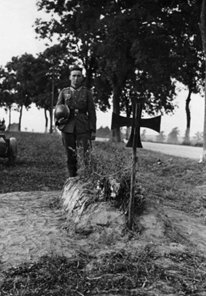

Fig. 5 (left, front) and Fig. 6 (right, back):
German soldier with his steel helmet taken off, standing in front of a soldier’s grave marked with an Iron Cross. On the back of the paper print of the PK photograph is a pre-printed caption slip with typewritten entries and approval stamps from the Wpr Department of the OKW and the Main Photo Press Office [Hauptreferat Bildpresse] of the RMVP. Contemporary caption: “Soldier’s grave near Crone. One of the first victims of the German advance into Poland. By the roadside lies the grave of a German combat engineer who gave his life for the Führer and the Volk on September 2.” [„Soldatengrab vor Crone. Eines der ersten Opfer des deutschen Vormarsches in Polen. Am Wegesrand liegt das Grab eines deutschen Pioniers, der am 2. September für Führer und Volk sein Leben ließ.“] September 6, 1939, Photographer: Heinz Boesig, PK 689 (Front: BArch, Image 183-2008-0415-507/CC-BY-SA; Back: BArch, Image 183-2008-0415-507/CC-BY-SA)
—
These slips differed in color depending on their intended use: PK prints “for official use only” [„nur für den Dienstgebrauch“] were to be accompanied by yellow slips, while those for press use were to be accompanied by white “Bildbegleitzetteln”. [80] The slips were to contain the following information: the photographer’s name, the location and time the photo was taken, and details about the image’s content. [81] Apparently, during the invasion of Poland, the PK photographers often submitted their prints with insufficient captions. This is suggested by repeated requests from the WPr Department to the censorship officers, such as the following one dated October 13, 1939: “All image material is to be censored and approved only if it includes a caption (explanation of the image). This will ensure that Bildberichter provide proper captions.” [82]
The PK paper prints, which were provided with sufficiently labeled “caption slips” were then subjected to military censorship. [83] This task was carried out by officers seconded from WPr Department III, who received their instructions directly from the OKW/WPr in Berlin and from the Staff Officer Ic (Enemy Reconnaissance and Counterintelligence, “Feindaufklärung und Abwehr”) of their respective army headquarters. The military censorship primarily ensured that all information regarding operational command, armaments factories, friendly casualties, and the supply situation was excluded. [84] After being cleared by the military censorship, the PK photo prints were stamped on the back with the abbreviation “Fr. OKW” (Fig. 6). [85]
The photos were then sent by courier to the RMVP in Berlin, where staff from the Press Photo Department [Bildpresse-Referat] carried out political censorship. [86] There, the PK press photo prints were stamped on the back with an approval stamp [Freigabestempel] that included a space for a date to be entered by hand (see Fig. 6: Stamp under “Fr. OKW”). If an image was not approved, this did not necessarily result in a permanent ban; it could also have been temporarily blocked for reasons related to current daily events. [87]
Once approved by the political censorship, the Photo Press Department [Bildpresse-Referat] forwarded the press prints of the PK photographs to the oligopoly of officially licensed, previously “Aryanized” photo news agencies [Bildnachtrichtenbüros], which then distributed them both domestically and abroad. [88] The “image caption labels” [“Bildbegleitzettel”] of the PK photos published by the photo news agencies [Bildnachrichtenbüros] were structured somewhat differently in terms of content than the labels for the prints produced by the PK itself. [89] They also differed in color to indicate different purposes: In addition to white accompanying labels for standard press usage, red “image labels” [“Bildbegleitzettel”] were also in use; these were intended for photo reports “whose publication is a priority” and which were to be printed “in a prominent position.” [90] A red “caption label” [“Bildbegleitzettel”] was attached for example to the press print of a PK photograph which shows dead bodies near Bromberg (Bydgoszcz) presented to foreign journalists during a press tour organized by the RMVP on September 7, 1939. [91]
The direct transfer of PK photos to newspaper and magazine publishers had been expressly prohibited in September 1939. [92] PK photographers did not receive a share of the proceeds from the sale of PK photographic material; instead, these proceeds were credited to a “Dr. Goebbels Fund.” [93] This circumstance may be the decisive reason why some of the most prominent PK photographers did not submit all of their photographs through official channels. [94] Various pieces of evidence and circumstantial evidence also suggest that quite a few PK photographers produced photographs and prints for private purposes, for example as gifts for superiors or the soldiers depicted. [95]
The PK photos reached the widest audience through the German press. Of particular note is their use in illustrated magazines and nearly 40 Wehrmacht field newspapers, [96] since during the war almost all men in the middle age groups – and later also teenagers and older men – were drafted into the military. PK photos were also used for posters, leaflets, and wall newspapers in the occupied territories [97] and distributed as picture postcards. [98] Numerous books published in 1939-40 following the end of the combat operations in Poland and illustrated with PK photos were also aimed at a wider audience. [99] Among the contemporary types of publications is also a lavishly illustrated pictorial book on the “Polish Campaign”, co-edited by Hasso von Wedel, containing 100 black-and-white stereoscopic photographs that, when viewed through the enclosed Raumbildbrille/3D glasses, were meant to convey a three-dimensional visual impression of the combat operations of 1939. [100] Press photographs from the “Polish Campaign” were also presented to smaller audiences in exhibitions [101] that sought to elevate the press images produced within military chains of command to the status of art.
The photographs of the combat operations in Poland published in the German press were by no means as reliable as they claimed to be. On November 24, 1939, the WPr Department informed its censorship officers that photographs of pre-war military exercises were being used to illustrate current military operations. [102] Sometimes, positive retouching [103] was also used to alter the content of a PK photo. A prime example of this is a photograph from the “Polish Campaign” of 1939 taken by PK photographer Sturm of the Luftwaffe War Correspondents Company 4, which depicts two PK men at work as war correspondents [“Kriegsberichter”]. [104] This image was published several times by Deutscher Verlag (formerly Ullstein-Verlag) starting in 1940, with a heavily retouched background: The image, dramatized with bright, blazing flames added later behind the two war correspondents, adorned among other places the cover of the first issue of the magazine Signal in 1940, which was intended to promote the German Wehrmacht in occupied, allied, and neutral countries abroad. [105]
PK photographs were also used in the German press directed at the Polish public. [106] The general tone of the Polish-language occupation press was that Poland’s defeat was final and that the power of Germany and its Wehrmacht was insurmountable. At the same time, attention was deliberately directed toward certain “enemies”: Jews in general, primarily England in 1939–40, and, from 1941 onward, chiefly the Soviet Union. [107] As in the former German Reich, daily newspapers in occupied Poland usually only printed a few PK photos. Their primary purpose was to illustrate the Wehrmacht’s successful advances on the battlefronts. PK photos were regularly used in larger quantities mainly in illustrated magazines. Several German-language illustrated magazines were published in Polish in the General Government. [108] The Ilustrowany Kurier Codzienny, [109] produced in Kraków by what was then Poland’s largest and most modern press enterprise, was appropriated by the German “Zeitungsverlag Krakau-Warschau GmbH” [110] in the course of the dismantling of the Polish press system [111]. In accordance with directives issued by the Main Department for Public Enlightenment and Propaganda [“Hauptabteilung Volksaufklärung und Propaganda”] in the General Government [112], its publications were intended to influence the Polish population intellectually and emotionally in line with the aims of the National Socialist regime. To give the appearance of continuity, the newspaper initially continued to appear under its former title [113] after Polish staff had been replaced with German managerial and journalistic personnel, and was then renamed to Ilustrowany Kurjer Polski (IKP) [114]. The editorial staff, consisting of German journalists who spoke Polish, used PK photographs supplied by the press services [Pressediensten] [115] of the Main Department for Public Enlightenment and Propaganda [Hauptabteilung für Volksaufklärung und Propaganda] in Kraków. The IKP also used PK photographs as elements in photomontages (Fig. 7).

Fig. 7: IKP, Vol. 3, No. 25, 12 June 1942, front page (photomontage)
—
The IKP used the PK’s photographs for its visual coverage of the war and for anti-Soviet propaganda with anti-Semitic undertones. [116] Although the IKP consistently defamed Jews, photographic depictions of Jews in occupied Poland were a rare exception in this publication. [117] In comparison, starting in 1941, some of the Americans who were frequently depicted in the IKP, on the one hand [118], and Soviet citizens, on the other, were regularly portrayed as “Jews.” [119] An examination of all issues [120] of the IKP led to the conclusion that – to an increasing extent starting in 1941 – up to about three pages per issue contained PK photos, the origin of which, however, was concealed from the readership. [121] Instead, named as image suppliers were the firms belonging to Berlin’s oligopoly of “Aryanized” photo agencies (Atlantic, P.B.Z., Scherl, Weltbild), the firm Presse-Illustrationen Heinrich Hoffmann, and, above all, Associated Press, thereby creating the impression that the photographs had originated from an American source.

Fig. 8: IKP, Vol. 2, No. 30, July 27, 1941, pp. 4–5. Title of the two-page photomontage, “To była linia Stalina,” printed in red on a two-color (red-green) background
—
In the IKP of July 27, 1941 (Fig. 8), a two-page spread was intended to illustrate the Wehrmacht’s advance into Soviet territory. The upper half of this double-page spread consists of a montage of three press photos – in the tradition of battle paintings – depicting the positions of German soldiers; these photos were retouched to link them together and enhance the drama. The German soldiers are depicted from behind, to give viewers the impression that they themselves are eyewitnesses to the events at the front. To illustrate the Wehrmacht’s air raids on “the enemy,” cutouts of airplanes were inserted into the sky at the top of the image. The transitions between the soldiers fighting on the ground and the aircraft in the sky were connected – especially on the left side – by clouds of smoke that were partly photographed and partly retouched into the image later. The horizon line outlined in the smoke was captioned in red, hatched capital letters: “That was the Stalin Line!” [„Das war die Stalin-Linie!“]
The cropping of a propagandistically significant image element in the IKP layout also played a key role in visually conveying the image of the enemy by directing the viewer’s attention to a specific focal point. In wartime propaganda, this occurred within the context of visual tropes that had already been employed in National Socialist visual propaganda of the 1930s, [122] including the visually contrasting juxtaposition of a national socialist group, identifiable by certain external characteristics (“cleanliness,” “uniformity” in movement and dress), and their “enemies.” This visual motif was also used to a limited extent in anti-Polish visual propaganda in 1940. [123] In the context of the invasion of the Soviet Union, this visual motif was used not only in the Berliner Illustrirten Zeitung, [124] but also in the IKP, primarily to portray Soviet soldiers and civilians in a derogatory way. Soviet citizens, who were portrayed as “unclean” or even “animalistic” [125], were visually contrasted with “clean” Germans, with the latter intended to appear not only technically but also “racially” superior. In the case of the Soviet Union, this iconography can also be traced back to the “Guidelines for Anti-Bolshevik Propaganda”, [126] issued as early as 1937, and an order from Propaganda Minister Goebbels dated July 5, 1941, which stated:
“A well-chosen selection of images – in which the animalistic [“vertierten”] Bolshevik types are contrasted with the free and open gaze of the German worker, the filthy Soviet barracks with German workers’ housing estates, the muddy, unpaved paths with German imperial highways [Reichsstraßen], and so on […] – is of great importance in this context.” [127]
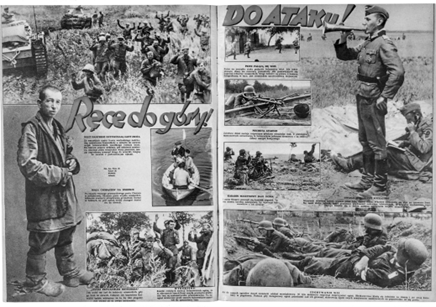
Fig. 9: IKP, Vol. 2, No. 38, Sept. 21, 1941, pp. 4–5. Headings
“Ręce do gory!” and “Do ataku!” in red on a black-and-white background
—
In this context, one should also note a double-page spread in the IKP (Fig. 9), which, on the left-hand page under the headline “Hands up!” [Ręce do góry!], features a compilation of photographs of surrendering Soviet prisoners of war, while the right-hand page, titled “To the attack!” [Do Ataku!], shows German soldiers during their offensive operations. On the outer edge of the left side is a civilian dressed in rags; based on the caption [128] he is a Soviet Jew captured by the Wehrmacht. [129] The large scale of this “miserable” figure distracts viewers’ attention from the fact that all the other photographs on this page show Soviet soldiers who are not dressed in rags. The IKP editorial team cited the following image providers: Associated Press, Atlantic, Scherl, and Weltbild. However, it is almost certain that these are exclusively PK photos. However, the origin of the visual material can be traced in detail only in rare, isolated cases. Nevertheless, the cropped image on the left of a “deterrent” Jew can undoubtedly be traced back to a photograph by PK photographer Schneider, published on September 3, 1941, by the Scherl company and held in the image archive of the Main Department of Public Enlightenment and Propaganda [Hauptabteilung Volksaufklärung und Propaganda] (Figs. 10 and 11).

Fig. 10 (left, front) and Fig. 11 (right, back):
A pauperly dressed civilian with short-cropped hair standing in front of a wooden wall. A press photo print measuring 18 x 13 cm on silver gelatin paper with a high-gloss finish. On the back is a white “photo caption sheet” [“Bildbegleitzettel”] for press use, containing typewritten information from the Scherl company in Berlin. It indicates that the photograph was taken by PK photographer Schneider and published by Scherl on September 3, 1941. Below the “Bildbegleitzettel” is a stamp from the “Government of the General Government – Propaganda Department” [“Regierung des Generalgouvernements – Hauptabteilung Propaganda”] and the handwritten note “B III 14 Soviet People” [“B III 14 Sowjetmenschen”], which is presumably the signature of the image archive of the Propaganda Department [Hauptabteilung Propaganda] in Krakow. In the lower right corner is a stamp from “Ilustrowany Kurjer Polski – REDAKCJA.” The handwritten notes “38/4/2 – 12.8 x 28” referred to the subsequent graphic processing steps for the publication of the image in the IKP (private collection)
—
For publication in the IKP, the background of the image was cropped out to make the central subject “stand out” for a montage. Any sympathy that might arise when viewing an “enemy” was prevented by a caption that imposed a negative interpretation of what was visible. This example illustrates the creative approach taken by the IKP’s photo editorial team. However, the way in which the PK photographers themselves visually constructed such enemy stereotypes can only be demonstrated through longer sequences of photographs. [130]
Another visual trope used by the RMVP in both German- and Polish-language “anti-Bolshevik” propaganda during the war was the depiction of the “enemies” from the East as a “mass” [a crowd] and as “types.” [131] In particular, the presentation of certain facial features against the backdrop of previously popularized racial-ideological standards of beauty [132] was intended to evoke revulsion in viewers. Both forms of visual representation of the “enemy” are combined in a photomontage that served as the cover image of the IKP on June 21, 1942 (Fig. 7). The source of the individual images used in this montage was not specified, but in this case as well, it can be assumed that PK photos served as the source material, since there is no evidence of other photographers being active on the German-Soviet front. The contemporary caption for this montage read: “With the help of such hordes, Stalin sought to dominate Europe, and Roosevelt and Churchill viewed this plan as ‘encouraging.’” [133] The term “horde” [“Horde”] is of central importance here, as National Socialist photojournalism sought to illustrate the “racial” inferiority of the Red Army through a repeated visual emphasis on the “Asian” soldiers (Fig. 12). [134]

Fig. 12: IKP, Vol. 3, No. 40, October 4, 1940, back cover of the issue
—
The visual portrayal of the Soviet military thereby created an anti-Semitic, anti-Bolshevik distortion that aimed to erase from the public consciousness the Poles, Balts, Ukrainians, Belarusians, and Russians who were fighting on the Soviet side against the Wehrmacht or who had become the civilian victims of the German invasion. [135] This becomes clearer when comparing complete sequences of photographs taken by PK photographers with the contemporary photojournalism [zeitgenössischen Fotopublizistik] of the time. The publications from that era document the contemporary visual meanings intended by the client who commissioned these photographs. This “intended iconography” [“beabsichtigte Ikonografie“] was based on the charge of “racial mixing” that the German Reich – invoking a völkisch ideology – had employed from the very beginning to legitimize the persecution, violent harassment, and disenfranchisement of certain groups of people. Before the war began, this primarily affected “Jews”; from 1939 onward, it also affected Poles, and from 1941 onward, the Soviet Union. A hallmark of the iconography of National Socialist visual propaganda directed against the multi-ethnic societies of Eastern Europe during World War II – into which the PK’s photojournalism [PK-Bildberichterstattung] was organizationally integrated – was the regular (indirect or direct) juxtaposition of a “völkisch” idealized self-image and a “racially” demonized image of the other.
On the spectrum of themes regarding PK photographs taken in Poland, with a close focus on the Holocaust
The primary purpose of the PK was to produce war propaganda glorifying the Wehrmacht. [136] The subjects depicted in the PK photographs from occupied Poland are linked not only to the course of the war and the glorification of war but also to the propagandistic objectives of the NSDAP as the state party. The preceding account of how reporting was organized and the procedures in place at the time regarding the PK images makes clear just how significant the German-Soviet conflict was, on the one hand, for the course of the war, and on the other, for the nature of Nazi visual motifs that were now being used on a transnational scale. The main adversary during the war on the Eastern Front was the Soviet Union, which, however, could not ultimately be defeated. The PK photographs taken in occupied Poland must also be understood within this context, particularly with regard to the periods in which they were created. Given the limitations of this framework, it is impossible to provide even a rough overview of all the image themes; therefore, only a few central thematic areas of PK photography and previously unexplored possibilities for their analysis and interpretation will be outlined.
The PK photos of the combat operations in Poland and their immediate consequences focus on September 1939 and the period from mid-1944 to early 1945. They depict German soldiers and their weapons, destroyed Polish military equipment, Polish prisoners of war and civilians, captured Polish cities, and fallen Polish soldiers. [137] Some visual objects that could have contributed to a realistic photographic depiction of the war were completely excluded. This applies in particular to German military casualties: fallen soldiers were to be depicted only in the form of soldiers’ graves (Fig. 5). [138] PK reporting consistently heroized German soldiers and officers. [139] Numerous PK photographs served to showcase the commanders and honor ordinary soldiers. [140] Since the PK units were deployed in consultation with the army staffs, the latter were able to influence the subject matter of the photographs to a limited extent.
The German soldiers who invaded Poland in September 1939 were portrayed as “liberators” of persecuted “Volksdeutscher” [“ethnic Germans”]. [141] This, combined with the claim that England had provoked the war, served as a moral justification for the invasion of Poland. [142]
To reinforce the propaganda message that this was not a war of aggression but a war of defense, the National Socialist leadership ordered that alleged Polish atrocities in and around Bromberg be “highly publicized” using shocking photographs from the PK 689 [143] showing dead civilians. [144]
On October 24, the RMVP issued a directive governing the portrayal of Poland in the German press following the end of German military administration (October 26, 1939). This order, which was given orally to German journalists during the Reich Press Conference [Reichspressekonferenz], has been preserved in two differently worded written versions. [145]
It must “be ensured that the current aversion to all things Polish is maintained for years to come. This aversion must evolve from a latent to a conscious one. Racial infiltration must be prevented. Poland is Subhumanity. Poles, Jews, and Gypsies must be mentioned in the same breath. There is to be no social or any other interaction with the Poles. A Pole is something impure that one does not concern oneself with. We will have to tolerate the Polish farm laborer among us for years to come, but we will isolate him as much as possible. […] Everything that is considered proper in Poland has German roots, including the culture. The idea that Poles are a subhuman race must become a ‘part of the subconscious’ [‘ein Bestand des Unterbewusstseins werden’] Reporting on the occupied territory is to be handled as part of the German living and cultural space.” [146]
This characterization of Polish citizens as “subhumans” in the form of “Poles”, “Jews”, and “Gypsies” was aimed at the long-term indoctrination of German society with ethnic and racial indoctrination [volkstums- und rassenideologische Indoktrination]. [147]
Starting in the spring of 1940, events in occupied Poland barely played a role in the German mass media due to the wars of aggression against other European countries. [148] The mass deportations of Poles that were beginning and the terror of occupation directed against the Polish civilian population were not covered in the mass media, which were controlled by the RMVP. [149] However, a distinction must be made between contemporary photojournalism [der zeitgenössischen Bildpublizistik] and the totality of PK photographs produced, as not all of the images were actually published. There are indeed surviving PK photographs of raids on the civilian population, for example, of a raid by the German Ordnungspolizei in Krakow in 1941, taken by a photographer named Kintscher of the PK 666 (Fig. 13). [150]
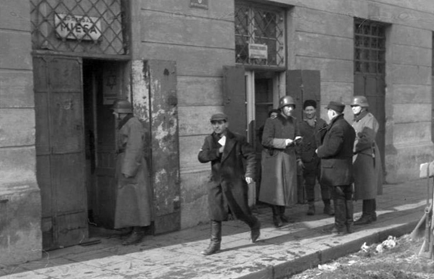
Fig. 13: Raid by the German Ordnungspolizei in occupied Kraków. At the entrance to the store on the left (“Mięsa”), a store sign featuring a Star of David is visible above the policeman’s helmet, January 1941, Photographer: Kintscher, PK 666 (BArch, Image 101I-030-0780-24/Kintscher/CC-BY-SA)
—
As early as December 1939, the German press published a selection of photographs by Artur Grimm, a member of a propaganda unit directly assigned to the OKW. [151] His photos were intended to make the German Security Police’s [Sicherheitspolizei, Sipo] measures against “Jews” in Warsaw appear necessary. These are staged scenes purportedly showing Jewish resistance fighters who, under the supervision of officials from the Warsaw branch of the Sipo and the SS Security Service [Sicherheitsdienst, SD] were forced to dig weapons out of a grave. The Jewish men were subsequently found guilty by an SD court-martial (Figs. 14–16). [152]

Fig. 14: Arrested Polish Jews are forced to confess to the “crimes” of which they are accused by the SS Security Service (SD) inside the Warsaw Jewish Community building, October 1939. Photographer: Artur Grimm, “OKW” Propaganda Unit (bpk 30032356)

Fig. 15: A detained Polish Jew is forced to sign a “confession” presented to him in Warsaw by the SS Security Service (SD), October 1939, Photographer: Artur Grimm, “OKW” Propaganda Unit (bpk 30010187)

Fig. 16: Arrested Polish Jews during a “trial” staged by the SS Security Service (SD) with a verdict already predetermined, October 1939; photographer: Artur Grimm, “OKW” Propaganda Unit (bpk 30010185)

Fig. 17: A group of SS SD officials in the building of the Warsaw Jewish Community (the same paintings seen in the background on the wall in Fig. 14 are visible in the upper right corner of the image) at 26–28 Grzybowska Street, likely during the announcement of the establishment of a “Jewish Council” [“Juderat”] for Warsaw on November 28, 1939. Photographer: Artur Grimm, “OKW” Propaganda Unit (bpk 30009881)
—
In November 1939, Grimm once again put the Warsaw SD staff in the picture when they gained access to the Jewish Community building yet again (Fig. 17), most likely in preparation for the establishment of the “Jewish Council” [“Judenrat”] for Warsaw on November 28, 1939, [153] which was now to comply with all instructions from the German occupiers. The occupying forces appointed Adam Czerniaków (Fig. 18) [154] as the “Jewish elder” [“Judenältesten”]; out of despair over the duty imposed on him to hand over several thousand Jews daily for extermination, he took his own life on July 23, 1942. [155]

Fig. 18: Officials of the SS Security Service (SD) and engineer Adam Czerniaków, whom they had appointed as “Jewish Elder” in Warsaw (center top), presumably also on November 28, 1939; photographer: Artur Grimm, “OKW” Propaganda Unit (bpk 30010016)
—
The PK photos of the police raid in Krakow and the activities of the Sipo in Warsaw were no longer related to purely military matters: their purpose was the targeted criminalization of civilians, accompanied by the visual reinforcement and construction of “racial” enemy stereotypes. In PK photos “enemies” were often depicted as members of supposedly inferior “races” in contrast to Germans who were considered “racially superior.” [156] While on the Western Front, Black French soldiers were the primary targets of “racial” enemy stereotyping, [157] in German-occupied Poland, Jews in particular were visually portrayed as “racially” foreign.
As early as September 8, 1939, the propaganda units were instructed to produce images for the Illustrierter Beobachter on the theme of “The Polish Jew”. The directive read: “Polish Jewish types of both sexes and various ages / Jewish occupations / Jewish customs / Jewish filth”. Another directive issued on October 2 called on several PK units to photograph “all kinds of Jewish types” in order to intensify anti-Semitic propaganda. [158] According to the prevailing view among the elites of the German Reich, the Second Polish Republic – which had been multi-ethnic until 1939 – represented a “racial mix” [“Rassengemisch“]. [159] Thus, during a visit to Łódź on November 2, Propaganda Minister Joseph Goebbels wrote in his diary:
“A drive through the ghetto. [160] We get out and take a thorough look around. It is indescribable. These are no longer human beings; they are animals. That is why this is not a humanitarian task, but a surgical one. We must make cuts here, and radical ones at that. Otherwise, Europe will one day perish from the Jewish disease. Drive along Polish roads. This is already Asia.” [161]
The terminology chosen by the Minister of Propaganda starkly expressed the highly biologistic and ahistorical worldview of the National Socialists: From the perspective of the NSDAP, which, with the Nuremberg Laws of September 15, 1935, had prohibited any romantic relationships with Jews and subsequently also with other “foreign races” [“Artfremden”] as “racial mixing”, [162] the Jews of Poland were an “Oriental foreign body” [“orientalischer Fremdkörper“] in Europe, equated with a health threat. [163] Starting in 1940, the German occupying forces herded all Jews found in Poland into designated forced-residence districts (ghettos) without adequate food or medical care, then labeled these areas as “quarantine zones” [“Seuchensperrgebiete”] or similar terms, and tirelessly claimed that Jews posed “health” risks. This process is partially documented in PK photos. [164] The ideological worldview of the racial ideologues did not correspond to the reality on the ground in occupied Poland, yet the occupation policy – shaped to a large extent by Heinrich Himmler’s SS and police apparatus – and the visual media controlled by the Propaganda Ministry distorted Poland’s reality of a multi-ethnic society to the extent that it came as close as possible to the racial-ideological utopia of the Nazi regime. [165] From 1941 onward, photopublishing coverage of Polish Jews was limited to visual depictions of closed ghettos. Neither their deportation to the extermination camps nor their uprisings in the ghettos were thematized in the mass media. [166]
Starting in 1941, Poland became a military staging area and a “transit country” for the Wehrmacht on its way to the Soviet Union. [167] Since numerous propaganda companies were deployed to the occupied territories of Poland in preparation for the planned attack, a large number of PK photographs of the ghettos were taken in the summer of 1941. [168] In addition to members of the Luftwaffe War Reporting Company 6169 [Luftwaffen-Kriegsberichterkompanie 6169], photographers from the PK 689 also documented the largest of these ghettos in Warsaw. A selection of the photographs from the PK 689 – which have been the subject of the longest and most extensive scholarly discussion – was published in the Berliner Illustrirten Zeitung in July 1941. [170] In this case as well, a comparison of the surviving photographic sequences with the photo reportage published around the same time leads to the conclusion that the PK photographers in the Warsaw Ghetto deliberately framed certain “types” in their shots in order to create a “deliberate iconography” [“beabsichtigte Ikonografie”] through photography, the meaning of which becomes clear only within the context of its own contemporary publication.
In 1941, additional PK and SS-PK photographs of ghettos in other cities were also taken. [171] These include, for example, photographs by the photographer Rössler (PK 666) from Kraków in 1941, which do not show the ghetto newly established in March 1941 in the Podgórze district – whose gate can be seen in some of the photographs by the PK photographer Koch [172] – but rather a market around the old synagogue in Kraków’s Jewish quarter of Kazimierz. [173] No information is currently available regarding the PK photographs from the Lublin ghetto. Photographer Johannes Hähle (PK 637) photographed two German soldiers strolling through the city here in May 1941 (Fig. 19). [174]

Fig. 19: Two German soldiers strolling through the streets of Lublin, May 1941, Photographer: Johannes Hähle, PK 637 (BArch, Image 101I-019-1229-34/Hähle/CC-BY-SA)
—
Upon closer examination of the people depicted in the middle ground of this photograph, it is impossible to uphold the tenet of racial-ideological anti-Semitism that Jews can be distinguished from other people by certain physical characteristics. Since the supposed visible differences between Jews and non-Jews were not a reliable distinguishing feature, the German occupying forces introduced a clearly visible identifier for Jews in late 1939: a yellow star in the “annexed eastern territories” [eingegliederte Ostgebiete] and a white armband with a blue star in the “General Government” [Generalgouvernement].
Apart from Warsaw, the most extensive collection of photographic sources pertains to the ghetto in Łódź. It differs from the collection concerning Warsaw in that there are a great many photographic sources by Jewish photographers from this ghetto, [175] which can be used for comparison with the PK photographs. By conducting a comparative analysis of photographs on the same subject that were taken independently of one another, the source value of individual images can be determined more precisely. [176] Such a comparison yields the remarkable result that PK photographs by no means consistently verify the axiom of racial-ideological antisemitism, but can also falsify it when analyzed in a source-critical manner with an understanding of the control processes described at the outset.
The multi-ethnic city of Łódź was renamed “Litzmannstadt” on April 11, 1940, on Hitler’s orders, in honor of his political ally General Karl Litzmann. [177] On April 30, German task forces established a completely sealed-off ghetto. [178] This was preceded by a requirement, effective November 7, 1939, that businesses be labeled according to their German, Polish, or Jewish “ethnic identity” [“Volkstumszugehörigkeit”]. [179] The ghettoization of Jews in 1939–40 went hand in hand with urban planning reforms aimed, in the medium term, at strictly segregating the “ethnic groups” [“Volksgruppen”] [180] within the city and, ultimately, at completely “Germanizing” them. This population policy segregation and town planning “Germanization” process, as captured in a photograph by PK photographer Knobloch (PK 689) taken in Litzmannstadt, appears to focus solely on the German construction efforts, the “Aufbau”-Leistung, in the city. [181]

Fig. 20: A PK member photographs a “Jew,” ca. 1940, Litzmannstadt (Łódź), Photographer: SS-PK Schilf (BArch Image 101III-Schilf-003-23/CC-BY-SA)
—
Presumably in 1940, SS-PK photographers Schilf and Wisniewski captured images of Jews crammed into the Litzmannstadt ghetto. [182] One of Schilf’s photographs (Fig. 20) provides insight into both historical realities and the social relationship between the German photographers and their photographed subjects. The photo shows a clean-shaven man in uniform holding a camera up to his face to take a close-up photo of a bearded civilian. The only way to identify someone as a “Jew” under the National Socialist racial laws is, at first glance, by the star that people classified as belonging to this group were required to wear on the right side of their chest and on their back in Łódź starting on December 11, 1939. [183] Schilf and the photographer pictured chose as the subject of their photographs a man who was visually identifiable as a “Jew” not only by the bright star on his coat, but also by the long dark coat itself (“kaftan”), combined with a full beard and head covering. Hasidic Jews dressed in this traditional manner were particularly often humiliated and photographed by German soldiers in uniform. [184]
Schilf’s photograph also allows us to analyze the nonverbal interaction between the photographers and the subject, as well as their positioning within the space. [185] The man, identified as “Jewish” by both his traditional clothing and the star he wears, stands frozen in place on an otherwise deserted square, facing two uniformed Germans who are photographing him at the same time. He is not looking in the direction of the photographer visible in the picture, who has approached him to take a close-up of “the Jew”, but is looking directly into the lens of SS-PK photographer Schilf, whose photograph is shown here. The two uniformed men taking the photograph reproduce a military and political power dynamic vis-à-vis the civilian being photographed, a dynamic that underlay all PK photographs of Jewish and non-Jewish Poles. As members of a technologically superior occupying power, they used the act of photography to demonstrate their power to a powerless man by taking pictures of him over which he had no control. The fact that the PK soldier visible in the picture is photographing him from as close a distance as possible is certainly not due to an inner empathy. [186]
In 1941, in addition to Knobloch from the PK 689, which was stationed in Warsaw, a photographer named Zermin [187] was also assigned to Litzmannstadt. [188] As a comparison of his photographs with those of the SS-PK photographers Schilf and Wisniewski shows, he portrayed the ghetto inmates differently than they did. For example, one of his photographs shows a Jewish ghetto policeman at work on the street, [189] whereas the two SS-PK photographers apparently intended, through their medium and close-up shots of ghetto policemen, to emphasize their “physiognomies” in particular. [190]
Numerous PK photographs by Zermin show Jews in the Litzmannstadt ghetto in 1941 as people who, apart from being marked with a star, did not differ from other Polish civilians (Fig. 21). [191] Some of his photographs show ghetto inmates at work in a tailor shop that produced uniforms for Wehrmacht soldiers (Fig. 22). [192]
The photographs taken by PK photographer Zermin convey a different impression than those taken by the SS-PK photographers of the Jews confined in the ghetto. Zermin’s images are more similar to those of the Jewish ghetto photographers, as they do not suggest any physiognomic or cultural difference of Jews. Why Zermin depicted Jews here as disciplined textile workers who were distinguishable from non-Jewish workers only by a sewn-on star cannot be clarified at this time. Like the PK photographs of middle-aged Jewish men working in the Warsaw Ghetto, these photographs were not published at the time. [193] It can be concluded, however, that PK photographs captured certain aspects of reality in the large ghettos; these must be precisely defined through comparison with other visual and written sources in order to distinguish, on a case-by-case basis, between objective information and propagandistic intentions.

Fig. 21: “Jews” confined in the ghetto, 1941, Litzmannstadt (Łódź), Photographer: Zermin, PK 689 (BArch Image 101I-133-0703-19/Zermin/CC-BY-SA)

Fig. 22: Tailoring workshop in the ghetto, production of Wehrmacht uniforms, 1941, Litzmannstadt (Łódź), Photographer: Zermin, PK 689 (BArch, Image 101-133-0719-02/Zermin/CC-BY-SA)
—
It is easier to distinguish between the objective informational content and the propagandistic intentions in cases where the available source material is relatively extensive and research into the historical context of the photographed events is relatively advanced. This applies, for example, to the Warsaw Uprising of 1944.
On August 1, 1944, the Armia Krajowa [Home Army], which was under the command of the Polish government-in-exile in London, launched an uprising in Warsaw that the German security forces – despite their superior weaponry – were only able to suppress after 63 days. Nearly 23,000 Polish insurgents engaged in a bitter struggle against the German occupying forces. By 1944, those fighting against the Polish insurgents in German uniforms no longer bore the slightest resemblance to the propagated ideal of “racial purity”: they included Hungarians, Belarusians, Russians, and numerous Azerbaijanis. [194]
Although the German leadership was determined to keep the public in the dark about the uprising, German war correspondents worked tirelessly on the ground, resulting in a large number of PK and SS-PK photographs documenting the fighting with the insurgents, surviving to this day. [195] On October 30, 1944, the RMVP banned the publication of all photographs of the Warsaw insurgents, claiming that they looked too “heroic” and “good.” [196] However, after several weeks of fighting, the RMVP and the OKW could no longer conceal this largest and longest uprising against the German occupying forces in Europe without suffering a significant loss of credibility. Consequently, reports on the fighting were distorted for propaganda purposes: General Tadeusz “Bór” Komorowski and his forces were portrayed not as Polish patriots, but as “tools in the hands of foreign powers” – namely, England and the Soviet Union. Komorowski was said to have forced the Polish civilian population to fight, thereby causing their suffering. [197] Correspondingly, a special edition of Signal published on 15 November 1944 also presented a distorted account of the armed uprising:
“The prelude to the Third World War – The Warsaw Uprising. On 1 August 1944, an uprising broke out in Warsaw. A few days later, it was crushed.” [198]

Fig. 23: Capture of a Polish “sewer fighter” [“Kanalgängers”] in the Mokotów district, Warsaw, 1944. Contemporary caption: “Warsaw – the end of a rebellion. After the collapse of the Warsaw Uprising. Fig. 23: Capture of a Polish “sewer fighter” [“Kanalgängers”] in the Mokotów district, Warsaw, 1944. Contemporary caption: “Warsaw – the end of a rebellion. After the collapse of the Warsaw Uprising. From crumbling cellars and damp sewer shafts, the half-starved insurgents, abandoned by Moscow and London, crawl out and go right into captivity” published on October 6, 1944, photographer: SS-PK-Ahrens (BArch, Image 146-1994-054-30/Ahrens/CC-BY-SA)
—
The RMVP had already banned all verbal and visual information intended for the public that could have led to the German population sympathising with opponents of the National Socialist regime. [199] Accordingly, the insurgents in Warsaw were now referred to, in line with the RMVP’s official rhetoric, as “fanatical bandits” [“fanatische Banden”], [200] whose “pockets of resistance” [“Widerstandsnester”] were being wiped out. Yet the PK and SS-PK photographs documented the use of heavy artillery, tanks, and the Luftwaffe against the insurgents. [201] These PK images, which remained unpublished at the time, together with other documents, demonstrate just how much the scale of this uprising was downplayed. On the instructions of the RMVP, foreign prisoners of war were generally to be portrayed as looking as “dejected” as possible. This general directive is also reflected in a photograph of a Polish insurgent who, like many others during the fighting, was able to move forward only by taking shelter in the underground sewer system (Fig. 23). [202]
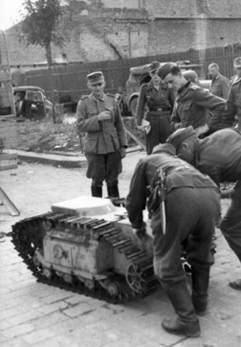
Fig. 24: German infantrymen deploying the “Goliath,” a miniature tracked vehicle loaded with explosives, against Polish insurgents in Warsaw, August 1944. Photographer: Götze, PK KBZ HG Mitte (BArch, Image 101I-895-0412-19/Götze/CC-BY-SA)
—
As the severe defeats suffered on all fronts from 1942 onward made it increasingly difficult to report on the heroic deeds of German soldiers and officers, the introduction of new weapons systems came to the forefront of PK reporting. [203] This likely also applies to many PK and SS-PK photographs of the fighting against the Polish insurgents in Warsaw in 1944, which focused the viewer’s attention not so much on the individual men as on the weapons they were using (Fig. 24). [204]
This also made it easier to conceal from the public the high proportion of non-German “auxiliary troops” [“HIlfstruppen”] wearing German uniforms.
Summary
As can be seen from the above, PK photographs depict only what is visible. However, since not all historically relevant events were or are visible, their analysis and interpretation should, as in art history, draw on additional textual and visual sources that shed light on the extent to which the conditions under which these images were created and how their contemporary uses limited the manner of visualization and the visibility of certain phenomena. In addition, their “intended iconography” must be taken into account, which can also be reconstructed by consulting contemporary textual and visual sources – such as relevant instructions and contemporary photopublishing. Such a reconstructive approach clearly reveals that the purpose of PK photographs taken during combat operations in the eastern theaters of war was not merely to report on the war and glorify the Wehrmacht, but also to construct images of the enemy.
As early as 1939, the German press was instructed by the RMVP to portray the population of the multi-ethnic society in the occupied Polish territories as “subhumans”. In 1941, the RMVP combined previously established patterns of anti-Semitic visual propaganda with an “anti-Bolshevik” visual program that had been temporarily suspended from 1939 to 1941. All of these elements of visual war propaganda presupposed the National Socialist racial ideology as the receptive context of the PK photography. In the eastern war zones, it facilitated and supported the Holocaust and the destruction of multiethnic societies in pursuit of a utopia already outlined in Hitler’s programmatic writings prior to 1933: the establishment of a colonial empire in the East, in which masses of impoverished “foreign peoples” [“Fremdvölkischer”] were to serve a minority of “Nordic” master races [“Herrenmenschen”]. [205]
Well before 1933, the NSDAP had clearly articulated the worldview that underpinned its violent assault on “foreign peoples” in the anti-Marxist slogan “Race instead of class” [“Rasse statt Klasse“]. Since the invasion of Poland, this motivation for action has been reflected in the criminal conduct of the German occupying power toward the members of a multiethnic society, which had now been divided into various “ethnic groups” [“Volksgruppen”]. This process of division and segregation within the multi-ethnic state of Poland – justified by racial ideology and hygienic-medical requirements – can be better understood through the photojournalism [Fotopublizistik] in the IKP than through media products intended for the German-speaking public.
While the construction of a racially ideologically based enemy image in German-occupied Polish territory up until 1941 through the work of the PK photographers – and in particular the SS-PK photographers – was largely limited to Jews, the visual defamation of all multiethnic societies in Central, Southeastern, and Eastern Europe – legitimized by the racial ideology of the “ethnic state” [“völkischen Staat”] – gained prominence through the visual imagery produced by the PK, with the invasion of the Soviet Union in 1941. This defamation became increasingly evident, at least from 1941 onward, in a deliberate exaggeration of the “filthy”, “animalistic”, and “Asian” in the “intended iconography” used to visually depict Soviet soldiers and civilians. [206] Systematic comparisons between complete series of PK photographs from the eastern war zones and their contemporary contexts of use in photopublishing under National Socialist rule can reveal just how great the discrepancy could be between the ethnic-racial [völkisch-rassischen] enemy stereotypes that were to be created and the visible realities encountered on the ground. The PK photographers had to bridge this discrepancy in order to comply with the instructions of the RMVP and the Wehrmacht Propaganda Department [Abteilung Wehrmachtpropaganda] at the OKW. [207]
A comparison of the PK photographs taken in German-occupied Poland with written sources and photographic sources from other producers shows that the PK’s photojournalism not only ignored the occupation’s terror against the civilian population and the industrialized extermination of “the mentally ill”, Jews, “Gypsies”, and Soviet prisoners of war, but also accompanied and supported these crimes through a visual program grounded in racial ideology, which gained its effectiveness not through individual images but primarily through the repetition of certain visual formulas and their mass reproduction. Any visualization of the events in occupied Poland from 1939 to 1945 that takes a critical approach to image sources will therefore not be able to rely solely on PK footage.
Of transnational significance is, first and foremost, the emergence of PK photographs in connection with a state crime of a scale previously unknown. In this context, when examining the photographs produced by the German Wehrmacht’s PK from a source-critical perspective, the question – formulated here in stark terms – must be asked to what extent they captured these crimes in images or whether they were produced with the intent of facilitating these crimes.
—-
Footnotes
[1] AHLRICH MEYER: Der Blick des Besatzers. Propagandaphotographie der Wehrmacht aus Marseille 1942-1944, Bremen 1999, p. 16.
[2] ANNIKA WIENERT: Tagungsbericht Bilderwelten. Fotografie, Film und künstlerische Bildproduktion in den nationalsozialistischen Lagern und Ghettos und deren Rezeption. 11.02.2011-13.02.2011, Neuengamme, in: H-Soz-u-Kult, March 7, 2011, http:// hsozkult.geschichte.hu-berlin.de/tagungsberichte/id=3566 (accessed March 16, 2011).
[3] See JENS JÄGER: Fotografiegeschichte(n). Stand und Tendenzen der historischen Forschung, in: Archiv für Sozialgeschichte 48 (2008), pp. 511–537.
[4] MIRIAM Y. ARANI: Die fotohistorische Forschung zur NS-Diktatur als interdisziplinäre Bildwissenschaft, in: Zeithistorische Forschungen 5 (2008), 3, pp. 387–412, here p. 393 (with detailed bibliographical references on the history of research), http://www.zeithistorischeforschungen.de/site/40208871/default.aspx (accessed on March 16, 2011).
[5] See W obiektywie wroga. Niemieccy fotoreporterzy w okupowanej Warszawie 1939-1945 = Im Objektiv des Feindes. Die deutschen Bildberichterstatter im besetzten Warschau, edited by CEZARY KRÓL and DANUTA JACKIEWICZ, Warsaw 2009.
[6] MIRIAM Y. ARANI: Fotografische Selbst- und Fremdbilder von Deutschen und Polen im Reichsgau Wartheland 1939-45. Unter besonderer Berücksichtigung der Region Wielkopolska, Hamburg 2008 (Schriftenreihe Schriften zur Medienwissenschaft, 19).
[7] OLIVER SANDER: Deutsche Bildberichter in Polen, in: W obiektywie wroga (as in note 5), pp. 31–47, here p. 32. See also the online finding aids and publications of the Federal Archives at http://www.bundesarchiv.de/ and http://www.bild.bundesarchiv.de/ (accessed on March 16, 2011). In December 2008, the Federal Archives made approximately 100,000 historical photographs from various periods of German history available to the online encyclopedia Wikipedia under a standard license for free use and redistribution. The archive designations of such licensed PK photographs are marked below with the suffix “CC-BY-SA.”
[8] http://bpkgate.picturemaxx.com/ (accessed on March 16, 2011).
[9] See Verbrechen der Wehrmacht. Dimensionen des Vernichtungskrieges 1941-1944, ed. by ULRIKE JUREIT, Hamburg 2002; Genesis des Genozids. Polen 1939-1941, edited by KLAUS-MICHAEL MALLMANN et al., Darmstadt 2004 (Veröffentlichungen der Forschungsstelle Ludwigsburg der Universität Stuttgart, 3); “Grösste Härte …” Verbrechen der Wehrmacht in Polen September/Oktober 1939. Exhibition catalog, edited by JOCHEN BÖHLER, Osnabrück 2005.
[10] See NORMAN DAVIES: : Europe at War 1939-1945. No Simple Victory, London 2006, pp. 19 ff., 24 ff., 71 ff., 94, 364–367.
[11] WOLF BUCHMANN: “Woher kommt das Photo?” Zur Authentizität und Interpretation von historischen Photoaufnahmen in Archiven, in: Der Archivar 59 (1999), 4, pp. 296–306, http://www.archive.nrw.de/archivar/hefte/1999/Archivar_1999-4.pdf (accessed on March 16, 2011).
[12] BERND BOLL: Das Bild als Waffe. Quellenkritische Anmerkungen zum Foto- und Filmmaterial der deutschen Propagandatruppen 1938-1945, in: Zeitschrift für Geschichtswissenschaft 54 (2006), pp. 974–998, here pp. 974–975. Most recently on the history and function of propaganda units, see DANIEL UZIEL: The Propaganda Warriors: The Wehrmacht and the Consolidation of the German Home Front, New York 2008; see the review by EUGENIA C. KIESLING, in: Michigan War Studies Review, April 2, 2009, http://www.michiganwarstudiesreview.com/2009/20090402.asp (accessed December 1, 2010).
[13] Many members of the propaganda troops returned to their former professions after 1945 and concealed their previous roles from the postwar public. For example, in 1951 Günther Heysing founded a veterans’ organization of the propaganda troops in Hamburg called “Wildente”, which aimed to portray the propaganda units and the Wehrmacht as separate from the Nazi regime, according to DANZIEL UZIEL: Propaganda, Kriegsberichterstattung und die Wehrmacht. Stellenwert und Funktion der Propagandatruppen im NS-Staat, in: Die Kamera als Waffe. Propagandabilder des Zweiten Weltkrieges, ed. by RAINER ROTHER and JUDITH PROKASKY, Munich 2010, pp. 13–36, here pp. 29 ff.
[14] BOLL (as in note 12), pp. 988, 996.
[15] WINFRIED RANKE: Fotografische Kriegsberichterstattung im Zweiten Weltkrieg. Wann wurde daraus Propaganda? in: Fotogeschichte 12 (1992), 43, pp. 60–73, here pp. 61–67 and 70 ff.
[16] MEYER (as in note 1), p. 17.
[17] HASSO VON WEDEL: Die Propagandatruppen der deutschen Wehrmacht, Neckargemünd 1962 (Die Wehrmacht im Kampf, 34), p. 37; and, in contrast, MEYER (as in note 1), p. 35; SANDER (as in note 7), p. 37.
[18] VON WEDEL (as in note 17), p. 148, and, in contrast, ARANI, Fotografische Selbst- und Fremdbilder (as in note 6), pp. 576 ff.
[19] See BOLL (as in note 12), p. 996; UZIEL (as in note 12), pp. 14 ff.; ARANI, Fotografische Selbst- und Fremdbilder (as in note 6), pp. 217 ff., 228–231, 247 ff.
[20] “Every artifact […] can only be interpreted and understood in terms of the meaning that human action (which may have very different objectives) imparted (or sought to impart) to the production and use of that artifact; without reference to this meaning, it would remain entirely incomprehensible.” MAX WEBER: Soziologische Grundbegriffe, München 1984, p. 22; cf. ARANI, Fotografische Selbst- und Fremdbilder (as in note 6), pp. 90–109, esp. pp. 102 ff.
[21] See ARANI, Die fotohistorische Forschung (as in note 4), and the same author: Fotografien als Objekte – die objektimmanenten Spuren ihrer Produktions- und Gebrauchszusammenhänge, in: Das Objekt Fotografie – „schön und nützlich zugleich“, ed. by IRENE ZIEHE and ULRICH HÄGELE, Münster 2006 (Visual Culture, 2), pp. 29–43.
[22] JAN BIAŁOSTOCKI: Skizze der beabsichtigten und der interpretierenden Ikonographie, in: Ikonographie und Ikonologie. Theorien, Entwicklung, Probleme, ed. by EKK-HARD KAEMMERLING, 4th ed., Cologne 1987, pp. 15–63.
[23] UZIEL (as in note 12), p. 14.
[24] Ibid., pp. 13, 28 ff.
[25] As cited in BOLL (as in note 12), p. 977.
[26] PETER LONGERICH: Nationalsozialistische Propaganda, in: Deutschland 1933-1945. Neue Studien zur nationalsozialistischen Herrschaft, ed. by KARL DIETRICH BRACHER, 2nd expanded ed., Bonn 1993 (Schriftenreihe Bundeszentrale für Politische Bildung, 314), pp. 291–314.
[27] EUGEN HADAMOVSKY: Propaganda und nationale Macht, Oldenburg 1933, p. 22.
[28] UZIEL (as in note 12), pp. 16 ff.
[29] Quoted in SANDER (as in note 7), p. 33; MEYER (as in note 1), p. 30.
[30] Cf. BOLL (as in note 12), p. 977; SANDER (as in note 7), pp. 32 ff.; UZIEL (as in note 12), p. 16.
[31] See BOLL (as in note 12), p. 978; UZIEL (as in note 12), pp. 17 ff. Excerpts from a corresponding publication by HASSO VON WEDEL titled “Wehrmacht und Partei” (1938) are reprinted in: Das Dritte Reich und seine Diener, ed. by LÉON POLIAKOV and JOSEF WULF, Munich, etc., 1978, pp. 421 ff.
[32] BOLL (as in note 12), pp. 979–982.
[33] According to an agreement dated July 26, 1940, the RMVP Department of Reich Defense [RMVP-Referat Reichsverteidigung] was responsible for this; see BOLL (as in note 12), p. 978.
[34] According to UZIEL (as in note 12), p. 26, this recruitment system continued well into the war.
[35] DORIS KOHLMANN-VIAND: NS-Pressepolitik im Zweiten Weltkrieg. Die „vertraulichen Informationen“ als Mittel der Presselenkung, Munich, et al., 1991 (Kommunikation und Politik, 23), pp. 37–40, 43–52, reconstructs the organizational process as follows: The RPA at the headquarters of the respective General Command [Generalkommando], in cooperation with the NSDAP Gau leadership [NSDAP-Gauleitung], compiled lists of eligible journalists. The lists of nominees were then forwarded to the Reich Defense Department [Reichsverteidigungsreferat] of the RMVP, where they were reviewed and supplemented. Subsequently, the nominated journalists were screened once again by the staff of the “Führer’s” deputy to ensure their political reliability.
[36] In each military district command, a Wehrmacht propaganda officer subordinate to Dept. WPr IIc [Abt. WPr IIc] had been assigned to the senior leadership; according to UZIEL (as in note 12), p. 27 ff.
[37] BOLL (as in note 12), p. 979.
[38] UZIEL (as in note 12), p. 27.
[39] See ARANI, Fotografische Selbst- und Fremdbilder (as in note 6), pp. 255, 257 ff.
[40] The term “press instructions” [“Presseanweisungen”] refers to the following collections of sources: the notes taken by two journalists at the “Reich Press Conference” [“Reichspressekonferenz”] (BArch, Zsg 101: Brammer Collection; BArch, ZSg 102: Slg. Sänger), the telegrams containing instructions from the “Reichspressekonferenzen” to the Reich Propaganda Offices [Reichspropagandaämter] (BArch, Zsg. 109: Slg. Oberheitmann), and Goebbels’ minutes from the ministerial conferences of 1939–1945.
[41] From the start of the war, ministerial conferences chaired by Goebbels were held daily at the RMVP; see: Kriegspropaganda 1939-1941, ed. by WILLI A. BOELCKE, Stuttgart 1966; Wollt Ihr den totalen Krieg? Die geheimen Goebbels-Konferenzen 1939-1945, ed. by the same author, Stuttgart 1967.
[42] See ARANI, Fotografische Selbst- und Fremdbilder (as in note 6), p. 280 ff.; JÜRGEN HAGEMANN: Die Presselenkung im Dritten Reich, Bonn 1970, pp. 95, 242, 288.
[43] See BOLL (as in note 12), p. 979; see also: Die Gleichschaltung der Bilder. Zur Geschichte der Pressefotografie 1930–1936, ed. by DIETHART KERBS et al., Berlin 1983.
[44] See VON WEDEL (as in note 17), pp. 2, 18 ff.; BOLL (as in note 12), p. 977; UZIEL (as in note 12), p. 15.
[45] BArch RH 19 XVI/8, pp. 102–109; cf. (by contrast) UZIEL (as in note 12), p. 17, based on ORTWIN BUCHBENDER: Das tönerne Erz. Deutsche Propaganda gegen die Rote Armee im Zweiten Weltkrieg, Stuttgart 1978, p. 19. These first five companies – PK 521, 537, 549, 558, and 570 – were assigned new numbers shortly before the invasion of Poland: the leading digit 5 was replaced by a 6.
[46] UZIEL (as in note 12), p. 18.
[47] VON WEDEL (as in note 17), p. 17.
[48] See BOLL (as in note 12), p. 989.
[49] Operational reports of PK 637 from the fall of 1939, BArch, Bild, Army Supplementary Volume to Collection 101I, pp. 45–56. As evidenced by the information compiled by UTE WROCKLAGE for the DVD: Verbrechen der Wehrmacht. Dimensionen des Vernichtungskrieges 1941-1944, published by the HAMBURGER INSTITUT FÜR SOZIALFORSCHUNG, Hamburg 2004, regarding PK photographer Johannes Hähle, photo reporters in the propaganda companies held at least four different military ranks (Sonderführer, Gefreiter, Leutnant, Unteroffizier); see DVD at the following path: Topics & Content/Topic Selection/3. Genocide/PC Station/Babi Yar/The Photographer (facsimile of the initial report on images and reports from PK 637 dated September 30, 1941).
[50] According to SANDER (as in note 7), pp. 31 ff., the units in question were as follows: in the Heeresgruppe Nord: PK 501 and PK 689; in the Heeresgruppe Süd: PK 621, PK 637, and PK 670; in the Luftflotte: Lw-PK 1 and Lw-PK 2, as well as Luftwaffen-Kommando Ostpreußen und Luftwaffen-Propaganda-Zug Ostpreußen; in the Navy: 1. Marine PK Ost. Cf., with some deviations, ARANI, Fotografische Selbst- und Fremdbilder (as in note 6), p. 572 ff.
[51] See SANDER (as in note 7), p. 32; UZIEL (as in note 12), p. 19. The PEA was later renamed the Propaganda Training Department (PAA).
[52] See VON WEDEL (as in note 17), pp. 53 ff.; UZIEL (as in note 12), p. 19.
[53] UZIEL (as in note 12), p. 20.
[54] BOLL (as in note 12), p. 987.
[55] See UZIEL (as in note 12), p. 20.
[56] Ibid., p. 20.
[57] See MARTIN MOLL: Die Abteilung Wehrmachtpropaganda im Oberkommando der Wehrmacht: Militärische Bürokratie oder Medienkonzern?, in: Bürokratien. Initiative und Effizienz, ed. by WOLF GRUNER and ARMIN NOLZEN, Berlin 2001 (Beiträge zur Geschichte des Nationalsozialismus, 17), pp. 111–150, here pp. 129–130; BOLL (as in note 12), p. 979; SANDER (as in note 7), p. 33; UZIEL (as in note 12), p. 20.
[58] UZIEL (as in note 12), p. 20 ff.
[59] See SANDER (as in note 7), p. 32, and UZIEL (as in note 12), p. 18 ff.
[60] BOLL (as in note 12), p. 984.
[61] Ibid., p. 986.
[62] SANDER (as in note 7), p. 38.
[63] See ibid., pp. 31, 38. For more information on the photograph shown here, see also: BArch, Image 146-1979-056-18A/CC-BY-SA; BArch, Image 183-E10457/CC-BY-SA and -E10458/CC-BY-SA.
[64] UZIEL (as in note 12), p. 21; ARANI, Fotografische Selbst- und Fremdbilder (as in note 6), p. 580.
[65] The regulations in the “annexed eastern territories” [„eingegliederten Ostgebieten“] and the “General Government” [„Generalgouvernement“] differed; see, on Greater Poland [Großpolen]: ARANI, Fotografische Selbst- und Fremdbilder (as in note 6), pp. 440–448, and on the General Government [Generalgouvernement]: Ibid.: Aus den Augen aus dem Sinn? Publizierte Fotografien aus dem besetzten Warschau 1939 bis 1945, in: Fotogeschichte 17 (1997), 65, pp. 33–58 (Part 1) and 18 (1997), 66, pp. 33–50 (Part 2).
[66] See BOLL (as in note 12), p. 994; ROLF SACHSSE: Die Erziehung zum Wegsehen. Fotografie im NS-Staat, Dresden 2003, p. 349; BArch RH 20-8/167: OKW to PK 649, Sept. 11, 1939; BArch RW 4/185, Bl. [fol.] 215: OKW and RMVP to all PK, Oct. 13, 1939.
[67] Beginning on August 1, 1941, responsibility for this fell to the newly established Photo Press Office [Bildpresseamt], a subordinate agency of the RMVP, which by 1943 had over one million PK photographs and an unspecified number of confiscated photographs from abroad; BOLL (as in note 12), p. 995; SACHSSE (as in note 66), p. 257 ff.
[68] BOLL (as in note 12), p. 983; SANDER (as in note 7), pp. 34 ff.
[69] Quoted from SANDER (as in note 7), p. 37.
[70] BOLL (as in note 12), p. 979.
[71] SANDER (as in note 7), p. 37.
[72] BOLL (as in note 12), p. 985.
[73] As quoted in SANDER (as in note 7), p. 37.
[74] As quoted in BOLL (see note 12), p. 992.
[75] See BArch Image 101I-010-0919-39/CC-BY-SA, June 21, 1941, Photographer: Georg Schmidt, PK 621.
[76] GEORG SCHMIDT-SCHEEDER: Reporter der Hölle. Propagandakompanien im 2. Weltkrieg, Stuttgart 1977, pp. 152, 162 ff., and 166, as cited in BOLL (see note 12), p. 992.
[77] A “good photo series” was considered the highest achievement of a PK photographer; see SACHSSE (as in note 66), p. 363.
[78] BOLL (as in note 12), p. 988.
[79] See SANDER (as in note 7), p. 34.
[80] Ibid., p. 33, note 33.
[81] Ibid., note 16.
[82] Quoted from BOLL (as in note 12), p. 990.
[83] Cf. ibid., p. 983.
[84] Ibid., p. 985.
[85] SANDER (as in note 7), p. 33; cf. SACHSSE (as in note 66), p. 343.
[86] BOLL (as in note 12), pp. 983, 986; VON WEDEL (as in note 17), pp. 20 ff.
[87] See BOLL (as in note 12), p. 982; BERND WEISE: Pressefotografie als Medium der Propaganda im Presselenkungssystem des Dritten Reiches, in: Gleichschaltung der Bilder (as in note 36), pp. 141–155, here pp. 148 ff.
[88] See BOLL (as in note 12), p. 983. The photo news agencies [Bildnachrichtenbüros] were subject to the “Reich Press Chamber” [“Reichspressekammer”] and were subject to similar state intervention as publishing houses; ARANI, Fotografische Selbst- und Fremdbilder (as in note 6), pp. 255, 259 ff.
[89] The accompanying notes [Begleitzettel] for the PK images distributed by the photo news agencies [Bildnachrichtenbüros] contained the accompanying text edited by the RMVP and, where applicable, additional instructions to the press editorial staff, the date the image was released, the name of the PK photographer and the photo news agency [Bildnachrichtenbüro], as well as the serial numbers assigned by the agency; see ARANI, Fotografische Selbst- und Fremdbilder (as in note 6), figs. III.30 and III.37.
[90] SACHSSE (as in note 66), p. 342 ff.
[91] ARANI, Fotografische Selbst- und Fremdbilder (as in note 6), pp. 212 ff. and 215, figs. III.36–37, as well as BArch, image 183-2008-0415-505/Fremke/CC-BY-SA (with contemporary markings retouched into the image to delineate the section to be published).
[92] SANDER (as in note 7), p. 33.
[93] SACHSSE (as in note 66), pp. 354–357.
[94] See the cases of Artur Grimm, Gerhard Gronefeld, and Johannes Hähle, whose PK photographs have been preserved in part through private or private-sector channels.
[95] MEYER (as in note 1), p. 30 ff.; SANDER (as in note 7), p. 38.
[96] SANDER (as in note 7), p. 39, notes 61–63 (with title references). As part of its support for the troops, each PK distributed a front-line newspaper for the army to which it was assigned.
[97] BOLL (as in note 12), p. 987.
[98] SANDER (as in note 7), p. 40.
[99] See bibliographic references in SANDER (as in note 7), p. 39.
[100] Die Soldaten des Führers im Felde. Raumbildalbum, edited by HASSO VON WEDEL and HEINRICH HANSEN, Munich 1939.
[101] SACHSSE (as in note 66), p. 352 ff.; SANDER (as in note 7), p. 39; BArch, Image 183- L02529/CC-BY-SA.
[102] According to BOLL (as in note 12), p. 990.
[103] Retouching on a paper print of a photograph, as opposed to retouching on the photographic negative film or glass plate.
[104] BArch, Image 101I-380-0075-15; ALEXANDER ZÖLLER: Soldaten oder Journalisten? Das Image der Propagandakompanien zwischen Anspruch und Wirklichkeit, in: Die Kamera als Waffe (as in note 13), pp. 167–179, here pp. 175 ff.
[105] Ibid., pp. 172–176.
[106] On the legal press in occupied Poland: LUCJAN DOBROSZYCKI: Die legale polnische Presse im Generalgouvernement 1939-1945, Munich 1977; LARS JOCKHECK: Propaganda im Generalgouvernement. Die NS-Besatzungspresse für Deutsche und Polen 1939-1945, Osnabrück 2006 (Einzelveröffentlichungen des Deutschen Historischen Instituts Warschau, 15).
[107] DOBROSZYCKI (as in note 106), pp. 65 ff., 113–117.
[108] Ibid., pp. 93, 95; JOCKHECK (as in note 106), p. 123.
[109] JOCKHECK (as in note 106), pp. 116, 129 ff.
[110] Ibid., p. 92; JOCKHECK (as in note 106), pp. 94 ff.
[111] In late October 1939, Hans Frank and Goebbels agreed to destroy all Polish mass media; DOBROSZYCKI (as in note 106), p. 61.
[A.d.Ü.: Diese zwei Fußnoten (110 und 111) sind aufgrund der anderen Satzstellung im Englischen anders nummeriert als im Originaltext.]
[112] JOCKHECK (as in note 106), pp. 69–79, 348 ff.
[113] Ibid., p. 130.
[114] The IKP was published biweekly starting on February 25, 1940, and weekly starting on October 6, 1940. I was able to examine this magazine thanks to a Feldmann travel grant from the DGIA Foundation.
[115] JOCKHECK (as in note 106), p. 121.
[116] For an example of the iconography, see the double-page spread titled “Czerwone gwiazdy z raju sowieckiego” [Red Stars from the Soviet Paradise] and illustrated with drawings in IKP, Vol. 2, No. 44, October 2, 1941, pp. 4–5. Beyond its connection to anti-Semitic elements, this “anti-Bolshevik” propaganda portraying enemies [Feindbildpropaganda] was part of a broader pattern within the IKP of consistently racist depictions of non-European “peoples” [“Völker”]; see, for example, IKP, vol. 2, no. 7, dated February 16, 1941, pp. 8–9 (Haiti) and No. 42 of October 19, 1941, p. 13 (India).
[117] Jews in German-occupied Poland were depicted in photographs in only two issues from 1940: IKP, Vol. 1, No. 1, dated February 25, 1940, p. 5 (single photograph), and No. 27, dated December 15, 1940, p. 12 (photo essay “Warszawskie Ghetto”).
[118] For example: IKP, Vol. 2, No. 12, March 23, 1941, pp. 2–3; No. 19, May 11, 1941, pp. 4–5; No. 31, August 3, 1941, p. 12; No. 33, August 17, 1941, p. 6; No. 40, October 5, 1941, pp. 8–9. Americans were predominantly represented visually by scantily clad showgirls.
[119] This corresponds to the main trends in anti-Semitic propaganda within the National Socialist controlled press during the war years, as described by HAGEMANN (see note 42).
[120] The 1943 edition could not be examined.
[121] Such unlabeled PK photos, depicting German troops, their successes, their enemies, and their prisoners of war, were found in the IKP for the years 1940 and 1941 in: Vol. 1, No. 7, May 19, 1940, pp. 6–7; No. 8, June 2, 1940, p. 7; No. 9, June 16, 1940, pp. 2–5; No. 10, June 30, 1940, pp. 2–3; No. 16, September 22, 1940, pp. 8–9; Vol. 2, No. 3, January 19, 1941, pp. 2–3; No. 10, March 9, 1941, pp. 4–5; No. 15, April 13, 1941, pp. 4–5; No. 19, May 11, 1941, pp. 4–5; No. 20, May 18, 1941, pp. 12–13; No. 24, June 15, 1941, pp. 4–5; No. 27, July 6, 1941, pp. 2–3, 7; No. 28, July 13, 1941, p. 1 (cover), pp. 2–5; No. 29, July 20, 1941, p. 1 (cover), 4–5, 7; No. 30, July 27, 1941, pp. 2–5; No. 31, August 3, 1941, p. 2; No. 33, August 17, 1941, p. 1 (cover), 2–5 (including Waffen-SS), 8–9; No. 34, August 24, 1941, pp. 2–5; No. 35, August 31, 1941, pp. 4–5, 7, 12; No. 36, September 7, 1941, pp. 2–3; No. 37, September 14, 1941, pp. 4–7; No. 38, September 21, 1941, pp. 2–5; No. 39, September 28, 1941, pp. 2–3, 5; No. 40, October 5, 1941, p. 1 (cover photo), 2–3, 4 (exceptionally explicit mention of the PK photographers Dietrich and G. Schmidt), 8–9; No. 44, October 2, 1941, pp. 2–3; No. 46, November 16, 1941, pp. 1 (cover), 2–5; No. 48, November 30, 1941, p. 1 (cover).
[122] See DIETHART KERBS, WALTER UKA: Beispiele nationalsozialistischer Bildpublizistik, in: Gleichschaltung (as in note 43), pp. 160–171, here pp. 164–171.
[123] See “Noch vor einem Jahr … und heute!” Photo essay by Hilmar Pabel on the Reichsgau Wartheland, in: Illustrierter Beobachter, August 15, 1940, pp. 820–821.
[124] Berliner Illustrirte Zeitung, July 17, 1941, pp. 764–765.
[125] See EDMUND DMITRÓW: Obraz Rosji i Rosjan w propagandzie narodowosocjalistów 1939-1945. Stare i nowe stereotypy [The Image of Russia and the Russians in National Socialist Propaganda, 1939–1945. Old and New Stereotypes], Warsaw 1997; Ibid.: Dehumanizacja obrazu wroga w propagandzie nazistowskiej na przykładzie broszury propagandowej “Der Untermensch” [The Dehumanization of the Enemy Image in National Socialist Propaganda: The Case of the Propaganda Pamphlet “Der Untermensch”], in: Rocznik Polsko-Niemiecki 6 (1997), pp. 91–114.
[126] See the DVD Vernichtungskrieg [War of Annihilation] (as in note 49), path: Themen & Inhalte/Themenauswahl/4. Sowjetische Soldaten in deutscher Gefangenschaft/PC-Station/Das Propagandabild/Antibolschewistische Propaganda im Nationalsozialismus und -/Das „Russenbild“ im Zweiten Weltkrieg. A contemporary “anti-Bolshevik” pictorial publication that conformed to these guidelines was: “Wohnkultur im Sowjetparadies” [“Home Life in the Soviet Paradise”] with seven photographs by SS-PK photographer Roth, in: Illustrierter Beobachter, September 7, 1941.
[127] Quoted from: Wollt ihr den totalen Krieg? (as in note 41), pp. 180–183.
[128] The caption in the IKP read: „‚Jestem przyjacielem Rothschilda‘/Tak wolał ten żyd do żołnierzy niemieckich, gdy go brali do niewoli. Ciekawe czy kapitalista Rotschild będzie wdzięczny za to, by taki plugawy żyd uważał go za swego przyjaciela.“ [“‘I am a friend of Rothschild.’ That is what this Jew shouted to the German soldiers when they took him prisoner. It is questionable whether the capitalist Rothschild will be grateful that such a filthy Jew considers himself his friend.”] The captions for the photographs published under National Socialist rule also followed the language guidelines of the secret press control [geheime Presselenkung], see HAGEMANN (as in note 42), p. 207 ff.
[129] See also other PK photographs of Jews in the territory occupied by Germany in 1941, such as the photo series by PK photographer Rudolf Kessler from Mogilev (Mahilëŭ) in Belarus: BArch, Image 101I-138-1083-3 [to -33]/CC-BY-SA and BArch, Image 101I-138-1084-02 [to -20]/CC-BY-SA; see also BUCHMANN (as in note 11).
[130] In a series of photographs taken by PK photographer Neumann (PK 691) in April 1941, depicting the roundup of Jews in Belgrade for forced labor (BArch, Image 101I-185-0112-03 to -38/CC-BY-SA), it is possible to see how the photographer, on the one hand, captured the “mass” of Jews rounded up for forced labor in wide shots (see BArch, Image 101I-185 -0112-07 to -11/CC-BY-SA) and, on the other hand, deliberately and repeatedly framed individual “types” in the shot (see BArch, Image 101I-185-0112-03, -05, -06, -17 to -19, -31, -32/CC-BY-SA). The defamatory intent of such medium and close-up shots of individual – in this case Jewish – “types” becomes particularly clear in the close-ups of individual facial “types,” understood at the time in “physiognomic” terms, featuring details intended to have a repulsive effect on later viewers: missing teeth, facial asymmetry, and the like. (see BArch, Image 101I-185-0112-20 to -24/CC-BY-SA).
[131] DVD Vernichtungskrieg [War of Annihilation] (as in note 49), Path: Pfad: Themen & Inhalte/Themenauswahl/4. Sowjetische Soldaten in deutscher Gefangenschaft/PC-Station/Das Propagandabild/ Die sowjetischen Kriegsgefangenen im Bild.
[132] See ARANI, Fotografische Selbst- und Fremdbilder (as in note 6), p. 353 ff.
[133] „Przy pomocy takich hord chciał Stalin opanować Europę, a Roosevelt i Churchill uznali ten plan za ‚bardzo podnoszący na duchu‘.“
[134] The caption for this photograph (Fig. 12) read: “Droga do niewoli. Trzej przedstawiciele pstrej mieszanej ludów Unii Sowieckiej, którzy poznali beznadziejność oporu, przechodzą z bronią w ręku na stroną niemiecką.” [“The Road to Captivity. Three representatives of the diverse peoples of the Soviet Union, having recognized the futility of resistance, are defecting to the German side with weapons in hand.”] The “Asians” depicted in German visual propaganda reflected the reality of the time inasmuch as numerous soldiers from Kazakhstan, Uzbekistan, and Tajikistan were indeed serving in the Red Army. For a “comparative viewing” of such images of “Asians” according to art-historical methodology – i.e., the identification of similarities and differences between two images through comparative observation of both – see ARANI, Objekt (as in note 21), pp. 30 ff. and illustrations on pp. 36, 39, and 41 – Barch, Image 146-1989-063-30A/Paris/CC-BY-SA is a good example.
[135] See, for example, DAVIES (as in note 10), p. 367; cf. BArch, Image 101I-006-2230-07/CC-BY-SA and -08/CC-BY-SA; BArch, Image 101I-217-0498-38/CC-BY-SA; BArch, Image 101I-187-0203-06A/CC-BY-SA; BArch, Image 146-1976-112-05A/CC-BY-SA; BArch, Image 183-L28726/CC-BY-SA and -L24469/CC-BY-SA.
[136] See UZIEL (as in note 12), p. 22.
[137] See the summary in SANDER (as in note 7), p. 34.
[138] Ibid., p. 37; see HAGEMANN (as in note 42), p. 286.
[139] UZIEL (as in note 12), p. 23.
[140] See MEYER (as in note 1), pp. 30–31.
[141] Boll (as in note 12), pp. 980 ff.; cf. JÜRGEN SCHRÖDER: Der Kriegsbericht als propagandistisches Kampfmittel der deutschen Kriegsführung im Zweiten Weltkrieg, Berlin 1965, p. 35 ff., and BArch, Image 146-1979-050-21A/CC-BY-SA; BArch, Image 183- E10713/CC-BY-SA.
[142] The fact that the German side had been planning a war of aggression against Poland since the spring of 1939 was to be concealed from the public. The RMVP issued instructions to date the start of the war not as September 1, but as September 3, 1939; see HAGEMANN (as in note 42), pp. 199 ff., 255, 265; cf. Nazi propaganda poster “Anglio! Twoje dzieło” [England! Your Work!] by Theo Matejko, Narodowe Archiwum Cyfrowe, ref. no. 37-242-1, and this poster in a contemporary PK photograph: W obiektywie wroga (as in note 5), p. 257.
[143] See ARANI, Fotografische Selbst- und Fremdbilder (as in note 6), pp. 573 ff., BArch RH 45/2 (family tree of PK 689) and BArch, Image 101I/Volume 121.
[144] For a detailed discussion of the sources and contemporary Bildpublizistik [image publications], see ARANI, Fotografische Selbst- und Fremdbilder (as in note 6), pp. 175–225; Ibid.: Wie Feindbilder gemacht wurden. Zur visuellen Konstruktion von „Feinden“ am Beispiel der Fotografien der Propagandakompanien aus Bromberg 1939 und Warschau 1941, in: Die Kamera als Waffe (as in note 13), pp. 150–163, here pp. 150–156; cf. SANDER (as in note 7), p. 35; BOLL (as in note 12), p. 981; SACHSSE (as in note 66), pp. 343 ff.
[145] EUGENIUSZ CEZARY KRÓL: Die Propaganda des Dritten Reiches gegenüber Polen und den Polen 1939-1945, in: W obiektywie wroga (as in note 5), pp. 15–30, here pp. 16 ff.; ARANI, Fotografische Selbst- und Fremdbilder (as in note 6), pp. 324 ff. A transcript of Press Directive [Pressenanweisung] No. 1306 (BArch Zsg 101/14) is reproduced in: W obiektywie wroga (as in note 5), p. 183; also cited in: HAGEMANN (as in note 42), p. 271, note 518, who excellently highlights the commanding nature of the RMVP’s “press directives,” which is absolutely necessary for understanding the nationalist system of press control.
[146] Quoted from HAGEMANN (as in note 42), p. 271.
[147] KRÓL (as in note 145), pp. 18 ff.
[148] Ibid., p. 20.
[149] Ibid., p. 21.
[150] SANDER (as in note 7), p. 36; BArch, Image 101I-030-0780-24, -25, -26, and -28/Kintscher/CC-BY-SA.
[151] ARANI, Fotografische Selbst- und Fremdbilder (as in note 6), p. 572; SACHSSE (as in note 66), p. 386, states that Artur Grimm was a member of a PK z.b.V. ObdH (zur besonderen Verwendung beim Oberbefehlshaber des Heeres – for special use by the Commander-in-Chief of the Army).
[152] W obiektywie wroga (as in note 5), pp. 194–199, 201. Some images from this photo series were published under the title “Waffen – in Gräbern versteckt! Der deutsche Sicherheitsdienst bei einer Razzia im Warschauer Getto“ in the Berliner Illustrierte Zeitung of Dec. 5, 1939, p. 1876; see also KLAUS HESSE: PK-Fotografen im NS-Vernichtungskrieg. Eine Bildreportage Artur Grimms aus dem besetzten Warschau 1939, in: Die Kamera als Waffe (as in note 13), pp. 137–149. The PK photographers did not capture the SS summary courts [SS-Standgerichte] that were used against non-Jewish civilians in occupied Poland in 1939. See, regarding the SS procedures in Poland that were specifically designed to create the appearance of “legality”: HANS-ERICH VOLKMANN: Verbrechen der Wehrmacht in Polen – Rahmenbedingungen und deutsche Nachkriegsrezeption, in: “Grösste Härte …” (as in note 9), pp. 24–38, here p. 30; DOROTHEE WEITBRECHT: Der Exekutionsauftrag der Einsatzgruppen in Polen, Filderstadt 2001 (Markstein diskursiv, 1), p. 50.
[153] BARBARA ENGELKING, JACEK LEOCIAK: Getto Warszawskie. Przewodnik po nieistniejącym mieście [The Warsaw Ghetto: A Guide to a Non-Existent City], Warsaw 2001, pp. 148 ff.
[154] The occupying forces demanded that Czerniaków submit a list of nominees for a “Judenrat” [“Jewish Council”] by October 13, 1939, and a list of all Jewish residents of Warsaw by October 28, 1939; ibid., p. 148.
[155] Ibid., p. 671. Starting on July 22, 1942, the “Judenrat” was to hand over 6,000 to 7,000 ghetto inmates daily for extermination.
[156] See UZIEL (as in note 12), p. 22.
[157] Ibid.; BOLL (as in note 12), pp. 984 ff.; HAGEMANN (as in note 42), p. 242, note 255; see also MEYER (as in note 1), pp. 90, 117, 140.
[158] As quoted in SANDER (as in note 7), p. 35.
[159] See ARANI, Fotografische Selbst- und Fremdbilder (as in note 6), pp. 420–426.
[160] This likely refers to the northern part of the old town of Łódź and the Baluty district, where the occupying forces subsequently established a forced residential area for Jews; see JULIAN BARANOWSKI: Das Getto Litzmannstadt, in: Berliner Juden im Getto Litzmannstadt 1941-1944. Ein Gedenkbuch, ed. by INGO LOOSE, Berlin et al. 2009, pp. 32–43, here pp. 35 ff.
[161] Die Tagebücher von Joseph Goebbels, ed. by ELKE FRÖHLICH, vol. 7, Munich 1998, p. 177.
[162] The “Gesetz zum Schutz des deutschen Blutes und der deutschen Ehre” [“Law for the Protection of German Blood and German Honor”] of September 15, 1935, was extended to include additional groups of people by Section 6 of the first ordinance on this matter, dated November 14, 1935; see SAUL FRIEDLÄNDER: Das Dritte Reich und die Juden. Die Jahre der Verfolgung 1933-1939, Munich 2000, p. 170.
[163] For a visual representation of this ideologem, see: Deadly Medicine. Creating the Master Race, ed. by UNITED STATES HOLOCAUST MEMORIAL MUSEUM, Washington 2004, ill. p. 103 (cover image “Neues Volk” 1938) and p. 192 (Nazi propaganda poster by G. Peiler “Żydzi – wszy – tyfus plamisty” [Jews – Lice – Typhus] for the General Government), the latter also reproduced in: W obiektywie wroga (as in note 5), p. 271.
[164] BArch, Image 101I-131-0596-13/Knobloch; BArch, Image 101I-322-2470-28/Ohmayer/CC-BY-SA; BArch, Image 101I-030-0794-38A/Brenner/CC-BY-SA; BArch, Image 183-L24628/Brenner/CC-BY-SA.
[165] On the scientific systematization of racial-biological selection and exclusion criteria in occupied Poland, see ARANI, Fotografische Selbst- und Fremdbilder (as in note 6), pp. 420–426, 431–435, 470–473, with further references.
[166] See KRÓL (as in note 145), p. 20 ff.; Im Kampf gegen Besatzung und „Endlösung“. Widerstand der Juden in Europa 1939-1945, ed. by GEORG HEUBERGER, Frankfurt am Main, 1995.
[167] KRÓL (as in note 145), p. 20. Warsaw became a transportation hub for the Wehrmacht’s advance eastward.
[168] SANDER (as in note 7), p. 36.
[169] UZIEL (as in note 12), pp. 22–23.
[170] On this cf. most recently ARANI, Feindbilder (as note 144), pp. 156–161; same author, Abbild oder Trugbild? Deutsche Fotografien von Juden in Warschau 1939–1944, in: W obiektywie wroga (as note 5), pp. 48–57, here p. 52 f.; cf. UZIEL (as note 12), p. 22. The first major German-language publications on the photographs of PK 689 were: Fotografien aus dem Warschauer Ghetto, ed. by ULRICH KELLER, Berlin 1987 (Das Foto-Taschenbuch, 9); SYBIL MILTON, Argument oder Illustration. Die Bedeutung von Fotodokumenten als Quelle, in: Fotogeschichte 8 (1988), no. 28, pp. 61–90, here p. 79.
[171] SANDER (as in note 7), p. 35 ff.
[172] BArch, Image 183-L22986 and -L25517/Koch/CC-BY-SA.
[173] BArch, Image 101I-030-0766-08, -20, -26, and -32/Rössler/CC-BY-SA.
[174] BArch, Image 101I-019-1229-30, -31, -33, and -34/Hähle/CC-BY-SA.
[175] Cf. ARANI, Fotografische Selbst- und Fremdbilder (as note 6), pp. 848–851, 893, 901; TANJA KINZEL, Zwangsarbeit im Fokus. Drei fotografische Perspektiven aus dem Ghetto Litzmannstadt, in: Im Ghetto 1939–1945. Neuere Forschungen zu Alltag und Umfeld, ed. by CHRISTOPH DIECKMANN and BABETTE QUINKERT, Göttingen 2009 (Beiträge zur Geschichte des Nationalsozialismus, 25), pp. 171–204; Das Gesicht des Gettos. Bilder jüdischer Photographen aus dem Getto Litzmannstadt 1940–1944, ed. by STIFTUNG TOPOGRAPHIE DES TERRORS, Berlin 2010.
[176] On methodology cf. ARANI, Fotografische Selbst- und Fremdbilder (as note 6), pp. 86, 106.
[177] BARANOWSKI (as in note 160), p. 32.
[178] Ibid., p. 36.
[179] Deutsche Lodzer Zeitung, November 7, 1939, p. 3, cited in: Germanizacja Łodzi w nazistowskiej prasie z lat 1939-1943. Wybór artykułów – Die Germanisierung von Łódź im Spiegel der nationalsozialistischen Presse (1939-1943), edited by KRYSTYNA RADZISZEWSKA and JÜRGEN RIECKE, Łódź 2004, pp. 14 and 72.
[180] See ARANI, Fotografische Selbst- und Fremdbilder (as in note 6), pp. 425, 470–473.
[181] BArch, Image 101I-133-0747-12/CC-BY-SA. The photo shows the facade of a building on ul. Piotrowska – now renamed Adolf-Hitler-Straße – during its “renovation” by a German “non-profit housing association” [“Gemeinnützige Wohnungsbaugesellschaft mbH”]. The photograph is part of the BArch collection, Image 101I/Volume 133/Film 747, containing photographs by PK photographer Knobloch from Litzmannstadt; see ARANI, Fotografische Selbst- und Fremdbilder (as in note 6), p. 916. The archival caption for the image is inaccurate in one respect: Adolf-Hitler-Straße had been off-limits to Jews since November 1939 and was located outside the ghetto grounds; see BARANOWSKI (as in note 160), p. 34; Germanizacja Łodzi (as in note 179), pp. 14, 25.
[182] On the SS-PK photographers Schilf and Wisniewski, see SANDER (as in note 7), p. 36. The forced resettlement of the Jews of Łódź into the city area designated as the ghetto took place between February and April 1940; see BARANOWSKI (as in note 160), p. 35 ff.
[183] Ibid., p. 32.
[184] See BArch, Image 101I-012-0048-17/Falk/CC-BY-SA; BArch, Image 101I-001-251-34/Schulze/CC-BY-SA; BArch, Image 183-E10855/CC-BY-SA; BArch, Image 101III- Wisniewski-025-21A and -22/CC-BY-SA; BArch, Image 101I-030-0780-25, -26, and -28/Kintscher/CC-BY-SA.
[185] For an analysis of photographic sources from a proxemic and kinetic perspective, see ARANI, Fotografische Selbst- und Fremdbilder (as in note 6), p. 99.
[186] See MEYER (as in note 1), pp. 32–35, and, regarding the operationalization of the analysis, ARANI, Fotografische Selbst- und Fremdbilder (as in note 6), p. 101.
[187] Some of his photographs have already been published by KELLER (see note 170), pp. 12, 171–187; contact prints of the negative film containing the photographs from the Litzmannstadt ghetto: BArch, Image 101I/Volume 133/Film 703.
[188] As evidenced by the surviving fragments of the company’s mission reports, members of this propaganda unit took photographs in the ghetto on February 12, 1941, and September 20, 1941; see ARANI, Fotografische Selbst- und Fremdbilder (as in note 6), pp. 574, 916.
[189] BArch, Image 101I-133-0703-32/Zermin/CC-BY-SA.
[190] BArch, Image 101III-Schilf-003-20 and -21/CC-BY-SA; BArch, Image 101III-Wisniewski-025-17/CC-BY-SA. According to contemporary “racial science” training materials, “Jews” were recognizable by certain physical characteristics, including the nose. However, RUDOLF VIRCHOW had already concluded that such physical characteristics could not be used to distinguish them: “Gesamtbericht über die von der deutschen anthropologischen Gesellschaft veranlassten Erhebungen über die Farbe der Haut, der Haare und der Augen der Schulkinder in Deutschland” [“Comprehensive Report on the Surveys Commissioned by the German Anthropological Society Regarding the Color of the Skin, Hair, and Eyes of Schoolchildren in Germany”] in: Archiv für Anthropologie 16 (1886), pp. 275–282. I would like to thank Prof. Dr. Konrad Vanja for this information.
[191] See also additional individual frames from the contact-printed negative film by PK photographer Zermin: BArch, Image 101I/Volume 133/Film 703; BArch, Image 101I-133-0703-27 and -35/Zermin/CC-BY-SA.
[192] Individual frames from the contact-copied negative film: BArch, Image 101I/Volume 133/Film 719; BArch, Image 101I-133-0719-05, -07, and -16/Zermin/CC-BY-SA.
[193] BArch, Image 101I-134-0770-05; ARANI, Feindbilder (as in note 144), p. 160 ff.
[194] See DAVIES (as in note 10), pp. 208 ff.
[195] Cf. W obiektywie wroga (as in note 5), pp. 336, 339–357.
[196] Quoted from SACHSSE (as in note 66), p. 364.
[197] W obiektywie wroga (as in note 5), p. 337.
[198] Facsimile in: W obiektywie wroga (as in note 5), pp. 364 ff.
[199] See HAGEMANN (as in note 42), p. 182.
[200] From the very start of the war, captured Polish civilians were to be referred to not as “captured Poles” but as captured “Polish bandits”; cited in SACHSSE (as in note 66), p. 344.
[201] See W obiektywie wroga (as note 5), p. 336 f.
[202] Cf. ibid., p. 357.
[203] UZIEL (as note 12), p. 23.
[204] Cf. W obiektywie wroga (as note 5), pp. 342–349.
[205] KARL HEINZ ROTH, „Generalplan Ost“ und der Mord an den Juden. Der „Fernplan der Umsiedlung in den Ostprovinzen“ aus dem Reichssicherheitshauptamt vom November 1939, in: 1999. Zeitschrift für Sozialgeschichte des 20. und 21. Jahrhunderts 12 (1997), no. 2, pp. 50–70. CZESŁAW MADAJCZYK, Vom Generalplan Ost zum Generalsiedlungsplan. Dokumente, Munich et al. 1994 (Einzelveröffentlichungen der Historischen Kommission zu Berlin, 80). Der „Generalplan Ost“. Hauptlinien der nationalsozialistischen Planungs- und Vernichtungspolitik, ed. by MECHTHILD RÖSSLER and SABINE SCHLEIERMACHER, Berlin 1993 (Schriften der Hamburger Stiftung für Sozialgeschichte des 20. Jahrhunderts, 3).
[206] Research into PK photographs from the territory of the former Soviet Union is complicated by the fact that neither the soldiers of the Red Army nor the estimated total of 27 million dead on the Soviet side can be clearly distinguished into Jews, Poles, Balts, Belarusians, Ukrainians, Russians, and “Asians.” This clearly demonstrates how ill-suited the category of national identity is for the scholarly analysis of World War II in Eastern Europe; see DAVIES (as in note 10), pp. 207, 210, 367 ff.
[207] The division of labor in the production, distribution, and publication of the PK photographs “relieved” individuals of responsibility for the final media product and its consequences, which ultimately also made it possible to deny any individual responsibility for the Holocaust and war crimes.
—
About the author
Miriam Yegane Arani did her doctorate at the UDK in Berlin under the supervision of the photo historian Prof. Diethart Kerbs. Her work focuses on the survey and analysis of photo-historical materials from the NS period. Her dissertation dealt with the Reichsgau Wartheland, where the Nazis implemented “exemplary” oppressive measures against the native Polish population. Similar methods were soon to be used in the old Reich territories in an increased dimension against the antagonized parts of the German, especially the German Jewish population. In the “Reichsgau Wartheland”, a German administrative unit newly formed from previously Polish territories after the military occupation, the Nazi regime realized its population and settlement policy plans for Eastern Europe in an exemplary manner.
Dr. Miriam Yegane Arani, http://propagandaundwiderstand.de
Tierautonomie
Publisher: www.simorgh.de – ‘Society, conflict and the anthropogenic dilemma’. Revised 06/2026. This reader is published in context with the memorial fund dedicated to Miriam’s work by the Edition Farangis.
Citation
Y. Arani, Miriam (2026): The photographs of the German Wehrmacht’s Propaganda Companies as sources on the events in occupied Poland 1939–1945. TIERAUTONOMIE, 12 (3), http://simorgh.de/tierautonomie/JG12_2026_3.pdf.
TIERAUTONOMIE (ISSN 2363-6513)
Our new header is by C. 勒 / Pegi Freespeech.
Original: C. 勒 und Tschördy, Antispeziesismus und Kunst: zu Demarkationslinien, p. 21.
In: E-Reader: Gruppe Messel, Jahrgang 6, Nr. 3, 2024.
ISSN 2700-6905. Edition Farangis.
https://d-nb.info/1323615423
https://d-nb.info/1323615423/34
Revised 12 June 2026
© Edition Farangis 2026