Can you think without your professor?

Can you think without your professor?

The academic discussion about animal concerns and where they meet human interests, is so detached from the reality of Animal Rights, that the discourse of these kind of animal ethicists seems in the core substance no more but a blast of sophist lapses branching out on a subject matter here only for secondary purposes but not because of Animal Rights themselves. What I think of are the heady discussions lead academically on the subjects of speciesism and anthropocentrism. Things may sound good, yet little way is given to nonhuman Animal Rights terms which would leave space for a nonhuman animal autonomy protecting against the human definition of “self” and “other”.

If we had a similar phenomenon in the academic discussion in regards to Human Rights, we would find ourselves in a futuristic soulless science fiction setting, where humans are no more but calculable sources to serve the interest of a hole.

The terms needed for and relevant to Animal Rights become politically practically useless when taken only to their abstract side and not to the side where a term is instilled with the aspects relating to the practical side of life – life’s daily political questions, that are concerned with environmental questions and the questions relating to Animal Rights concerns.

The worst form of an abstraction would be to go back to point zero and ask: what are Animal Rights again and which animals should have what exact rights. From an Animal Rights standpoint we take Animal Rights as a given ethical imperative and prerequisite. Similar to the understanding of RIGHT in Human Rights, my right is not dependent on any holy issue or on any group’s decision to grant me rights or even on the evolutionary side of being a humanoid. The sheer fact of existence grants the right that will take its own shape in the individual, and of course rights do conflict, and still we should try to live peacefully if we want to or if we can.

Political Animal Rights

So far we haven’t gained as much and enough political momentum as is needed in the inner national and supra-national political settings that constitute themselves with the political party systems, umbrella orgs, lobbyism driven by economical factors, NGOs, philanthropists and yes even grassroots work that we do in our communities directly or over the internet.

To rely on the possibility that academic discussion would take us any further with the needed political momentum for the Animal Rights movement, and how general society perceives the question of Animal Rights and how AR can go together with Human Rights, will be a long and disappointing wait.

Academia coins terms, but these terms become shallow after they go through the entire digestive system of the typical academic brain.

Which terms would we need, however?

We need to fill the space of the Animal Rights discussion basically with the same soul, with the same concern, idea, words, deeds …  such as we apply to our own concerns. Theories have their good, but the practice of life that in the end of the day makes up our political side of life, needs the individual strength of thought and deed.

We are able to talk about our own concerns, and we are also able to talk about the concerns of our fellow animal friends.

Never rebut an enlightened anthropos – how dare you!

Why it is amazing how Animal Rights sets ITSELF on the right fundament. No question that it does exactly that, Animal Rights is a story, dynamic in itself.

However some birthhelpers who are perhaps a couple of eons too late are fighting for their new inventions of the wheel notwithstanding. Ok, what I’m talking about is the question of the futile fight of humans against their own perpetually continued ANTHROPOCENTRISM.

A lot of focus is currently set by the AR community on just that impotant question, which is good and a thing to do overdue because it helps you see reality clearer. Reality about the political implications of Animal Rights for Human Rights and Earth Rights mostly, I believe.

But what exactly is anthropocentrism?

Also … Why is a term chosen that strictly seems to omit the animal nature connection as the KEY point and only focuses on the human towards animal relation in a critical way though. What about that, what completely stands out of the reach of us the anthropos??? Ok, so we see the question at stake here is the perspective, we want to avoid looking at the world from a strictly homocentric viewpoint. But how far do we have to go with that.

I was recently criticised for criticising an AR advocate who is against anthropocentrism and who claims that Animal Rights find a reasonable argument in the similarities between beings – humans and nonhuman animals that is. This is an old string of argumentation when animal acvocacy issues are being discussed. But: do we want to land at comparative studies where we check one brain against the other to find out how much rights you should be entitled to be granted? Well, the amount of speciesism in the enlightened field of AR advocates is just plain tiresome. I just stop this rant at this point and ask you to continue it on your own behalf if you will.

An end to philosophical validity can lie in what we perceive to be reality

The human continuum with its cultural values is not necessarily one, and can’t necessarily be unified with its diverseness.

Every individual has the right to hold her or his own views.

Thus I can be for Animal Rights INASMUCH as I can be for Human Rights, for example.

No philosophical school can propose me their argumentation as valid IF it asks me to see nonhuman animals other than I see them now as an Animal Rights person.

Philosophy should stay out of attributing different “life forms” with their labels of value or meaning.

Otherwise philosophy becomes as bad as how religions function – as doctrines based on belief. Homoncentrists believe that nonhuman animal life matters less than human life,  and they believe that the world relevant to nonhuman animals and the systems meaningful to nonhuman animals life must not be regarded as a complete world in its own rights in their own terms.

Speciesism isn’t …

Speciesism isn’t like something that has to be assumed like a “status quo” that we are just condemned to be living with for ever. Speciesism is always an almost inexplicable disaster for which we lack any real terms to fathom that what is happening.

It’s not an issue that’s less pressing than violations of human rights.

Even if Animal Rights are not legally pronounced anywhere in our homocentrist human societies now, the world consists of an autonomous natural world too (in a parallell form) of which nonhuman animals are the inhabitants and nonhuman animals are rights bearers in the vital positions they hold in the environment /nature.

Our manipulative and destructive mingling in their matters does not change anything about the animal-nature connection – which is far more fundamental than our conceptions of might and force are, which we have set against them.

My friend ‘Comet’ adds rightly: “The entire existence of humanity is not something that goes “way back” as far as the universe and its age is concerned. So all of humanity from the start until now – although “ages and ages” to humanity – is still a catastrophic event in the eyes of the universe, as much as Nazi Germany was a catastrophic event to humans. So one can look at the whole of humanity and say ‘that event went totally wrong, time to start over ‘”.

Where do you draw the line, when asking others to act up – ethically?!

Where do you draw the line, when asking others to act up – ethically?!

chatty <3

I often wonder myself about what i can ask of others and what i can ask of myself, as when it comes to: what’s ethically ok, what can we do, and what is asked too much for most people (and even understandably asked too much?).

I don’t want to imply in any way with what I am saying here, that the “do whatever you want to” approach would be a recommendable path to seek in our daily practiced ethics.

What I mainly find worth highlighting in the context is this:

How about letting others down who really need my help and I could help them? Ok many of us would think I am talking about things relating to friends and family. but that’s not what I mean. What I mean is – extend your circle: helping “strangers”.

It shouldn’t be provocative to ask, my question is: is having ones “own” kids a form of letting “others” down by denying the “others” the support I could give them if I instead would chose to feel responsible just as much for them as I would for my own kids?

The other day I heard a fellow vegan talk about vegans who don’t care if exploitative “cheap” labor or any oppressive means were involved in the production process of vegan produce bought, that a vegan person’s care should ideally reach out to the questions of human rights inasmuch. This of course is an undeniably important critical point to bring up. Also this vegan person highlighted the need of a stronger awareness in the fields of veganism and environmentalism and how these two go together, and finally she briefly discussed the importance of making your kids aware of speciesism.

Thinking about vegan parenting made me think of the dilemma everybody of us faces when confronted with the decision: my life as how i would (possibly) want it for myself (having kids) or what about the kids that are born but who really don’t have much of a chance in the world for how we all are setting this world up anew every day.

I’ve taken the decision now. I don’t feel extravagant for having decided to put all my support into helping other’s kids,  nonhuman and human alike, primarily.


on the multiplicity of meaningfulness

A concern is a concern, and should and can be “of concern” / “something that concerns one”, even if it’s not a concern to many people.

An issue is of importance, even if that issue is not a story that makes the headlines. We get easily drawn into the streams (!) of uniform opinions, thoughts and feelings, when one issue is played up and stands on the main menu of “today’s top stories”. We easily lose out of sight that our individual thinking and actions need more independence and that our thinking and actions should not be a play-ball of the “moods of the masses”.

When our own individual thinking becomes only a part of one big uniform stream of opinions (that heads just in the one “either-or” direction), our existence shrinks to a binary reducedness. We could end up being one of those “zombies” that we run into every day. Those type of people that are straight one of the stupid or one of the smart side. Life however goes beyond us being stupid or smart, I think life is so complex that leaving all our doors of perception open to what we can learn from it, requires us to allow a full multiplicity of a meaningfulness that does cover more than just our own “insight/s of humanity”. We need an outlook onto all concerns. Beyond homocentrism.


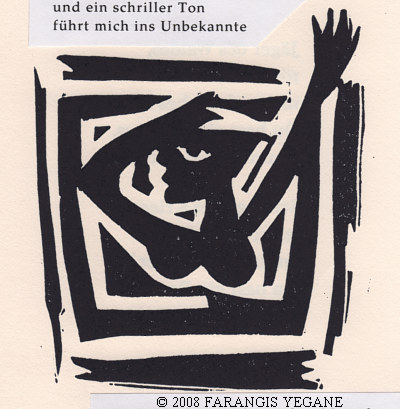
a linoleum print by Farangis G. Yegane

animal rights pornography – definition

animal rights porn – definition

A corporate advertisement that extols the company’s ethically motivated animal rights or animal protection measures taken, their record or policies – usually by a company known to rape and pillage nonhuman animal concerns as thoroughly as possible.

A: Have you seen those new campaign targets by the PETA, that show how easily “animal friendly” can become a swear word?

B: They are pure AR porn, man.

or rather

A: Have you seen PETAs recent campaign for animals?

B: Don’t fall for that! Check their policies on euthanasia.

ar-pornography animal rights pornography, considerate about nonhumanbeings interests washing

Ok maybe peta makes an animal rights porn site to try to ridiculously cover up that fact that they are animal rights porn.

You can’t call a lip service “help”, you can’t even call a an action “help”, when all the “help” you think you are giving is undone by the next steps you are taking. … And that even routinely in the case of peta and their active euthanasia of nonhuman animals. Also, their campaigns cater to an anti AR rethoric and only thus gain a lot of support from the people loyal to them, who helplessly “bark upon the wrong tree”. If people don’t see that being for or against animal rights is not a matter of belonging to a certain group, but that it’s actually actions and opinions that matter, then those people can rightly be called ethically short sighted.

The Parallel, fragment about the position humans take towards “nature”

The Parallel, fragment about the position humans take towards “nature”

The homocentrical human considers himself to be in a parallel position to the other natural phenomenons. Nature is felt as if merely producing itself out of an almost passive condition, nature is seen as a huge complex of causalities with interlocked phenomena.

The subsumation: “nature” stands in homocentrist terms for something passive, “nature” has been banned into a virtual state of a “meaningwise” non-existence, while the idea of “the human” is thought to exclusively represent a comprehensive awareness and meaningfulness.

There is an imaginary parallel condition, and on one hand you have the so called passive “natural world” and on the other hand you have the so called “aware” human state of being.

That means in other words that what is external to the human state of being, is localised and being put into the dimension of standing in opposition, in a specific type of way. This type of way is most easily to be compared with the parallel: THE PARALLEL STANDS IN RELATION BUT WITHOUT AN INTERCHANGING (DIRECT) CONNECTION.

A parallel, which represents an ideal circumstance for measuring the one side to the other, seen from the perspective of denying the existence of the others by classifying everything except the “self-concept” as being relatively narrow in function. That what is other, is not simple enough to be fit into the simplicity of the system of homocentricity. The reality of Animals and the Nature is too complex – obviously.

This also means, a highly complex form is subjugated to being translated into the simplifying procedure of scientific proof, to then be considered as a bit more important on its side of the parallel. The complexity remains on its side of the parallel, and cannot jump the line, but can increase in meaning alone by its being existent in the same dimension as the human being is.

The separation, that the parallel creates, stands in dependence of the understanding of “self” (the self-concept), since nothing else would be able as effectively to banish the one immediate reality, that could threaten to run into the acts of definition, human inductions and deductions.
THE REAL could end up dissolving the homocentrical tendency for creating determinisms … .

Feminism and Animal Rights, the one way or the other …

Feminism and Animal Rights, the one way or the other …

“Meat” is not porn and it’s not sexist – “meat” is flesh, and it’s the result of a human/humans killing a nonhuman animal/animals. We should not stick our own sociological issues to such a major own concern such as Animal Rights in an analogy that sets itself so close to the subject of comparison, that the story gets one-sided and a new and important perspective gets neglected.

All Animal Rights issues need an own valid terminology and frame of reference, otherwise we blur the lines … .

The analogy of sexism and speciesism

Two main points why Animal Rights issues can’t be tied to a “purely” feminist viewpoint ( – if feminism is used as excusing women from the responsibilities in society ethically towards their nonhuman environment)

It’s wrong to presuppose that speciesism is something that is more prevalent in men compared to women.

Also, male nonhuman animals are inasmuch sexually abused in the farm industry (their reproductive system) such as female nonhuman animals are.

Both points should be expanded upon in detail of course. (I do hope I can do that to a later date.)

Close analogies … also of genocides and speciecides

These types of close analogies in the field of -isms and abuse work in a valid way when we look at the psychology of the “perpetrator” who seeks to create a victim: the aspect of exerted violence share many similarities, whereas however on the side of the victimized we have to see the contexts: political, enviro-political, historical, sociological, … a group or an individual gets picked as a victim for reasons, and those exact reasons need to be analyzed under own terms, and not be conflated.

Food ethics

veganism is veganism is veganism, perhaps

You get either those one who prioritize their self-concern by talking endlessly about health and yummy food  – instead of giving one basic useful info about how you can be creative eating and cooking with a staple diet consisting of fruit veggies and herbs and spices and legumes and grains.
Or, you get those ones who prioritize their self-concern by talking endlessly about why human rights really matter more that animal rights, and why we can’t expect people to change their “food choices” who live in hard contexts – instead of talking about where vegetarianism really came from: namely from cultures and peoples all over the world and history, who chose ethical and resposible diets.
Both types are mostly interested in how they can make their careers with veganism and get their money. In reality they see veganism as some political (hopefully) social fashion. Which it is though.

To sum it up: the plant based diet and the animal rights driven ethics of people create two major strands of opportunists currently, who put their homocenstist outlook for us as a nonplus ultra of veganism.

I don’t want to try to trash some people’s positive intents, I just think that an eagerness for one’s own “survival” grounded on using a morally and ethically weighty subject, will inevitably cause conflicts between the requirements of the subject dealt with, and the needs of steps that I ought to take in order to “reach something” (money, fame, and such) in the types of societies we live in today.