Animal Rights: why there is a similar concern for establishing them alongside human rights

Hello friend: if you read this post or look at it, make sure you have a look and this tumblr entry too. Please talk with your friends about the atrocities of animal sacrifices,be they for religious craziness or for whatever … http://niceswine.tumblr.com/post/12614331791/i-heard-about-the-killing-of-camels

Animal Rights: why there is a similar concern for establishing them alongside human rights

What do you feel are your rights dependent upon? The first instance when you learn about how important it is that you have rights is as a child. If you don’t have rights, anybody might marginalize you because you are weaker than them. Other humans can be in that negative sense the “stronger” ones, that they can potentially just violate the integrity of your individuality completely.

Your rights depend on the basis that the social context amongst which you live shows respect towards you, and accepts that you are weaker in some sense. Additionally the social context around you must leave you the space to “fulfil yourself” to a meaningful (for yourself) and reasonable extent.

Rights have basic social patterns which they require, in order to function “organically” almost. And even more, rights require in their social context and embedding a broader frame of fundamentals. Within this “frame of fundamentals” you will find the entire environmental contexts – nonhuman animals included at the forefront.

The environment is not something passive that is born out of causalities that started off with a big bang universe theory … and nonhuman animals are not the biological instinct bearers as the natural scientists might want to explain them in an oversimplified yet extraordinarily body-centred way. When we make assumptions about what is important in the assumed “instinctual life of an animal”, we just put our assumptions about the animal’s priorities right over them like a cloak under which the real animal will not become to be seen. When I understand that some bird species does some specific singing because he/she wants to mate, then I assume that is what is happening, but I should not claim my assumption to be mirroring the truth of the nonhuman animal. That what is not understood, what remains a world not fully understood by me, can still be a measuring standard in it’s own terms, even if outside my cognitive grasps reach.

Overall, the habitat in which we live is way too complex to be described in solely logical terms, even. On the irrational side yet again, that what we can see in nature is what religions have “sterilized” by setting against natures own (incomprehensive) complexity their single mighty god/divine concepts, as some all inclusive surrogates – with hidden features like a human miracle- producing brain that creates the world and universe and so on. In real life we all have a direct connection to the grandiosity of nature though, that basically totally independent of any prescribed views on it. After all we are part of this universe too. In our singularity. As lonesome single beings.

To come back to where I initially started, animal- and humans rights need each other to go hand in hand, because if we separate our desired rights as superior to what we might only see as the “needs” of animals, then we should ask ourselves: on which planet do we live and with whom are we dealing here? If we will stay and head into a prolonged thinking of us as the centre of the universe, then we will isolate our capacities of thinking and feeling to a perversely narrow circle of ourselves reflecting just what we want to see.

Does life have to be tragic?

Does life have to be tragic?

Certainly people create situations for each other as human beings, but far more than that even for other, nonhuman animal beings and the natural world and the world as a whole, situations which can’t even be hardly fathomed anymore by a word such as “tragic”, situations which leave the one who experiences them horrified and terrified, sad to the highest extent.

“Tragic” is something personal, something that can’t be really located in the broad and politically relevant context, when it refers to the experience of an individual.

No matter what though, we all do suffer from tragic fates, caused by the impacts humans create.

How do we handle our personal tragic experiences, and not let ourselves be emotionally drowned by the bad experiences and thus by others causing such feelings in us?

I think it’s important that we connect that what happens to us personally (I mean on the very private and personal scale) to that what happens in the world and with the world overall. Our personal tragedy is caused by humans who ignore that their lifestyles in all aspects (the ideas the propagate, their behavior, the practical impacts of their doings and their “havings”) affect the actual life of single individuals on really all possible scales.

Humans in the western world on average seek to rationalize their lifestyle by terms such as what is “in” and what “I should have” / own / possess, what is “normal”, what should be everybody’s standard, what is it that “I like”, that “I want”, that I “need”.

The question about the broad “you” is not interesting and even a no no. One simply works against it. The “you” is something like an opposing principle.

We need this “you” to live though! But we should be aware not to reduce it to be a fake “you”, which would consist just of clones of ourselves. It’s a matter of perspective. There is a difference between a collective egotism and an individualist “concernism” or altruism.

Tragedy hinders us from connecting to the other, we become locked within the perspective of the “I” involuntarily. But as we can’t share the feelings of an egotist who causes us to feel tragic in the first place, we end up suffering from the separation we feel between a locked “I” and an out-locked “you”.

Let’s break out of the locked “I” condition when we feel our tragedy, and let’s always see that we are connected with the many “you’s”.


on the multiplicity of meaningfulness

A concern is a concern, and should and can be “of concern” / “something that concerns one”, even if it’s not a concern to many people.

An issue is of importance, even if that issue is not a story that makes the headlines. We get easily drawn into the streams (!) of uniform opinions, thoughts and feelings, when one issue is played up and stands on the main menu of “today’s top stories”. We easily lose out of sight that our individual thinking and actions need more independence and that our thinking and actions should not be a play-ball of the “moods of the masses”.

When our own individual thinking becomes only a part of one big uniform stream of opinions (that heads just in the one “either-or” direction), our existence shrinks to a binary reducedness. We could end up being one of those “zombies” that we run into every day. Those type of people that are straight one of the stupid or one of the smart side. Life however goes beyond us being stupid or smart, I think life is so complex that leaving all our doors of perception open to what we can learn from it, requires us to allow a full multiplicity of a meaningfulness that does cover more than just our own “insight/s of humanity”. We need an outlook onto all concerns. Beyond homocentrism.


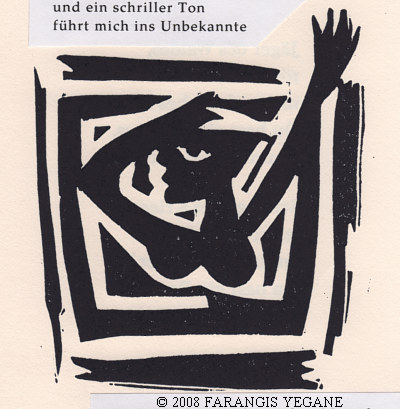
a linoleum print by Farangis G. Yegane

Society is politics, but only as what regards their political philosophy

Society is politics, but only as what regards their political philosophy

The private is a chaotic raw base (a necessary, “natural” base). It can be described with psychological terms in the singular and sociological terms in the plural of humanity.

The political sphere needs philosophy, ethics and concepts. It seeks a basis of reason upon which different single individuals can agree.

The sociological just takes people as “how they are”, no matter what their ethical ideals could turn them into on the longer run, whereas the political perspective on society gives society a reason.

The private finds its full potential only when it becomes aware of it’s own ability to create reason, embeds it in a frame of organization that is set as a potential ideal.

Then, even if a person never lives under politically reasonable conditions, the aspiration itself, phrased, thought or practiced on the small scale by the thinking individual, creates a political meaningfulness.

MEANINGFULNESS, that is: One in which the single individual steps out of its own concern onward to show responsibility towards its entire contextualities – regarding nonhuman animals, the natural environment and human beings.


Feminism and Animal Rights, the one way or the other …

Feminism and Animal Rights, the one way or the other …

“Meat” is not porn and it’s not sexist – “meat” is flesh, and it’s the result of a human/humans killing a nonhuman animal/animals. We should not stick our own sociological issues to such a major own concern such as Animal Rights in an analogy that sets itself so close to the subject of comparison, that the story gets one-sided and a new and important perspective gets neglected.

All Animal Rights issues need an own valid terminology and frame of reference, otherwise we blur the lines … .

The analogy of sexism and speciesism

Two main points why Animal Rights issues can’t be tied to a “purely” feminist viewpoint ( – if feminism is used as excusing women from the responsibilities in society ethically towards their nonhuman environment)

It’s wrong to presuppose that speciesism is something that is more prevalent in men compared to women.

Also, male nonhuman animals are inasmuch sexually abused in the farm industry (their reproductive system) such as female nonhuman animals are.

Both points should be expanded upon in detail of course. (I do hope I can do that to a later date.)

Close analogies … also of genocides and speciecides

These types of close analogies in the field of -isms and abuse work in a valid way when we look at the psychology of the “perpetrator” who seeks to create a victim: the aspect of exerted violence share many similarities, whereas however on the side of the victimized we have to see the contexts: political, enviro-political, historical, sociological, … a group or an individual gets picked as a victim for reasons, and those exact reasons need to be analyzed under own terms, and not be conflated.

Thoughts about the languages of animals

multicolored dog by farangis yegane

THOUGHTS ABOUT THE LANGUAGES OF ANIMALS
Palang Latif

I can’t see how a term such as ‘animal language’ could pose a problem to anybody when it directly refers to an animal’s way of communication. I am however critical of people who ‘translate’ animals in stereotype ways.

Nevertheless I could apologize for using a word that describes the phenomenon that humans see as exactly the very one criterion which most sharply shows the difference between humans and all other animals. The word ‘language’ has evolved in the human mind and possesses as such its linguistic legitimacy.

The word ‘language’ belongs to one of the core conceptions of the most drastic forms of negative speciesism. Regarding this presumed ground I have to stand upon, I apologize for the insufficience of my attempt to communicate something for which I can insofar only borrow this word, and I dare to ask you to perhaps think of a second word ‘language’ – free of value in a sense – which would only describe what we may not be able to describe yet within the borders of our set of regulations as we have them currently in regards to language; I am well aware that people usually don’t want to accept that this one human term ‘language’ can be used tightly paralleled to animal language, and that so far the word ‘animal language’ has only be tolerated on a scientifical level to refer to human parameters that have been applied to animal communication.

Animals speak their languages, but what their languages consist of, could only be understood if we communicated with them on a level that allows them to use their language.

Animal languages work like human languages, where you can translate what you understand and try to put how-you-can-understand-the-message or that what you understand into your terms of your language.The same happens when I talk to any other individual: I comprehend what she/he/it conveys in the restrictedness or unrestrictedness of my own terms. My terms don’t merely underly semantics – though they might be translated back and forth into semantics, morphems and syntax. My own terms and concepts have, in spite of their belonging to my system of language, a restricted meaning. In a very basic sense I have to rely on that what I understand or confer to that what I perceive.

The languages of animals (there are more animal languages than human languages of course) are seen by us as having a super restricted meaning. If we take the position of the nonhuman side in general, we can say though that human languages are restricted in that they only apply to humans. And seen from a standpoint which takes into account the question of perspective, I can say that if I don’t understand a dog, it’s because she belongs to a different animal ‘group’ when compared to my human group.

‘Communication’ infers meaning to the act of communicating on any level of any sound produced by a communicative agent.

Does language necessarily have to be connected to the history, the past, the present and the future of human progress? Why should animals have ever evolutionary or in any wise chosen to contextualize their existence with the human existence? A being of an animal group or I’d like to say an animal culture, clearly differenciates that what is important to their own existence; and I would call this rather their philosophy instead of just an evolutionary occurence.

I find it permissible to use a word of the human language to describe something I witness, on an experiential basis, about the side of someone (animals) who uses another language. Also ,I prefer to call the expresssed existence of nonhuman animals a philosphy, since it is too simple and anthropocentrically self-serving to underlie animal existence pure evolutionary ends. I do draw from my personal observations which seem sufficient for me to make my own judgements in this case and to make a decision about what to think here.

Basically I think that everybody knows that animals have their languages, but that we usually deny that these languages, that we don’t understand, have any meaning at all. But how would we not deny any meaning of animal communication that would go beyond the notions that our societies generally have about even the being itself of animals; we deny the fact of a self-authorative being of animals in itself in it’s whole meaning. So, no surprise that we draw major qualitative lines. In terms of language, we create a complicated building of restrictions to exclude the nonhuman animals from the comparatively tolerant perspectives that we have in regards to the pluralism of human languages. (It’s ok for a human language to be completely different, just because it’s human.)

We deny another animal that it’s not instinctal, because it’s not a human. You can indeed call everything an instict. Still you can’t really prove that it is “instict”. You can just put the ‘supposed carrier of an instict’ in a setting where they are treated as such instinctual things and seen as such, and interpreted as such.

Possibilities

Human rights in favour of animal rights may hopefully be another way to convey that an opinion of a human majority can’t represent a truth about any individual animal and the whole animal groups:The animal individual itself is a truth-bearer since it exists, and simply by that it represents, through how it lives (in its own rights and in its own terms) a truth. Just like I judge humans I meet by the impact of truth (their actions are possible just by shere existence), I would want to be as just as I can towards the ways in which individual animals live.

Art doesn’t function through semantics, since there are shapes and colours!
Micky Mouse doesn’t function through semantics, since there are figures and action!
Snowball doesn’t function through semantics, since there is Lisa taking her seriously enough!
Music doesn’t function through semantics, since there is play and composition!
Oppression doesn’t function through semantics, since there are suppressors
Love doesn’t funtion through semantics, since there is understanding and misunderstanding
Peace doesn’t funtion through semantics, since there are underlying actions … And this array could go on and on. Anyway, and still this is all part of our language?

What we do when we speak about ‘animals’ and ‘language’ is: We reduce the complexity of animal communication to linguitstical terms into which they may not fit. Instead of admitting the existence and relevance of other communicative systems as being really independent from our systems and thus not explainable through purely and solely biologcal criteria (insinct).

I have compounded two things:

1. the function of the term ‘instinct’ as a) serving to restrict the notion of a socio-ethical plane as to only having developed in and being attributable to humans and ‘human groups/cultures’ and b) its intended reduction of the scope and meaning of communication in nonhuman animals to a biologically explainable and manipulatively determinable code,

and 2. I have defined linguistics as an inadequate means of setting general rules for a communicative validity.

Instincts and linguistics are things that are working in our systems of categorisation.

In regards to the self-cetegorization going along with this, I also want to point out that our own language does not base a) on merely a functional basis neither in connection to the agent that uses language nor in connection with the subjects that language seeks to deal with, and b) that our language might also not just be a compound of what linguistics (and maybe physiological aspects of speaking added or so) alone can make out of it.

Generally: Cultural (in a non-homocentric sense, i.e. implying “the natural” on an equal scale)) and individual aspects play a role too, as well with humans as with animals when communicating!

I do state again that the word culture can to my opinion also be applied to animals – if one allows a culture to be really and profoundly different [from “our” cultures] too.

The multicolored dog in the top left corner is by Farangis Yegane, from her book ‘Farbenlehre’ – Color Theory, see an excerpt here: http://www.simorgh.de/objects/251107_1 .

This essay ist also on my veganswines.com site at: http://www.veganswines.com/andishe/animallanguage.htm and published in my veganswines reader 08 (Paddling of the Ducks educational press) in a printed form.