Animal Rights: why there is a similar concern for establishing them alongside human rights

Hello friend: if you read this post or look at it, make sure you have a look and this tumblr entry too. Please talk with your friends about the atrocities of animal sacrifices,be they for religious craziness or for whatever … http://niceswine.tumblr.com/post/12614331791/i-heard-about-the-killing-of-camels

Animal Rights: why there is a similar concern for establishing them alongside human rights

What do you feel are your rights dependent upon? The first instance when you learn about how important it is that you have rights is as a child. If you don’t have rights, anybody might marginalize you because you are weaker than them. Other humans can be in that negative sense the “stronger” ones, that they can potentially just violate the integrity of your individuality completely.

Your rights depend on the basis that the social context amongst which you live shows respect towards you, and accepts that you are weaker in some sense. Additionally the social context around you must leave you the space to “fulfil yourself” to a meaningful (for yourself) and reasonable extent.

Rights have basic social patterns which they require, in order to function “organically” almost. And even more, rights require in their social context and embedding a broader frame of fundamentals. Within this “frame of fundamentals” you will find the entire environmental contexts – nonhuman animals included at the forefront.

The environment is not something passive that is born out of causalities that started off with a big bang universe theory … and nonhuman animals are not the biological instinct bearers as the natural scientists might want to explain them in an oversimplified yet extraordinarily body-centred way. When we make assumptions about what is important in the assumed “instinctual life of an animal”, we just put our assumptions about the animal’s priorities right over them like a cloak under which the real animal will not become to be seen. When I understand that some bird species does some specific singing because he/she wants to mate, then I assume that is what is happening, but I should not claim my assumption to be mirroring the truth of the nonhuman animal. That what is not understood, what remains a world not fully understood by me, can still be a measuring standard in it’s own terms, even if outside my cognitive grasps reach.

Overall, the habitat in which we live is way too complex to be described in solely logical terms, even. On the irrational side yet again, that what we can see in nature is what religions have “sterilized” by setting against natures own (incomprehensive) complexity their single mighty god/divine concepts, as some all inclusive surrogates – with hidden features like a human miracle- producing brain that creates the world and universe and so on. In real life we all have a direct connection to the grandiosity of nature though, that basically totally independent of any prescribed views on it. After all we are part of this universe too. In our singularity. As lonesome single beings.

To come back to where I initially started, animal- and humans rights need each other to go hand in hand, because if we separate our desired rights as superior to what we might only see as the “needs” of animals, then we should ask ourselves: on which planet do we live and with whom are we dealing here? If we will stay and head into a prolonged thinking of us as the centre of the universe, then we will isolate our capacities of thinking and feeling to a perversely narrow circle of ourselves reflecting just what we want to see.
Where do you draw the line, when asking others to act up – ethically?!

Where do you draw the line, when asking others to act up – ethically?!

chatty <3

I often wonder myself about what i can ask of others and what i can ask of myself, as when it comes to: what’s ethically ok, what can we do, and what is asked too much for most people (and even understandably asked too much?).

I don’t want to imply in any way with what I am saying here, that the “do whatever you want to” approach would be a recommendable path to seek in our daily practiced ethics.

What I mainly find worth highlighting in the context is this:

How about letting others down who really need my help and I could help them? Ok many of us would think I am talking about things relating to friends and family. but that’s not what I mean. What I mean is – extend your circle: helping “strangers”.

It shouldn’t be provocative to ask, my question is: is having ones “own” kids a form of letting “others” down by denying the “others” the support I could give them if I instead would chose to feel responsible just as much for them as I would for my own kids?

The other day I heard a fellow vegan talk about vegans who don’t care if exploitative “cheap” labor or any oppressive means were involved in the production process of vegan produce bought, that a vegan person’s care should ideally reach out to the questions of human rights inasmuch. This of course is an undeniably important critical point to bring up. Also this vegan person highlighted the need of a stronger awareness in the fields of veganism and environmentalism and how these two go together, and finally she briefly discussed the importance of making your kids aware of speciesism.

Thinking about vegan parenting made me think of the dilemma everybody of us faces when confronted with the decision: my life as how i would (possibly) want it for myself (having kids) or what about the kids that are born but who really don’t have much of a chance in the world for how we all are setting this world up anew every day.

I’ve taken the decision now. I don’t feel extravagant for having decided to put all my support into helping other’s kids,  nonhuman and human alike, primarily.


on the multiplicity of meaningfulness

A concern is a concern, and should and can be “of concern” / “something that concerns one”, even if it’s not a concern to many people.

An issue is of importance, even if that issue is not a story that makes the headlines. We get easily drawn into the streams (!) of uniform opinions, thoughts and feelings, when one issue is played up and stands on the main menu of “today’s top stories”. We easily lose out of sight that our individual thinking and actions need more independence and that our thinking and actions should not be a play-ball of the “moods of the masses”.

When our own individual thinking becomes only a part of one big uniform stream of opinions (that heads just in the one “either-or” direction), our existence shrinks to a binary reducedness. We could end up being one of those “zombies” that we run into every day. Those type of people that are straight one of the stupid or one of the smart side. Life however goes beyond us being stupid or smart, I think life is so complex that leaving all our doors of perception open to what we can learn from it, requires us to allow a full multiplicity of a meaningfulness that does cover more than just our own “insight/s of humanity”. We need an outlook onto all concerns. Beyond homocentrism.


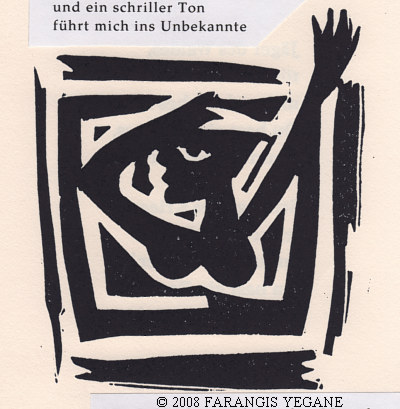
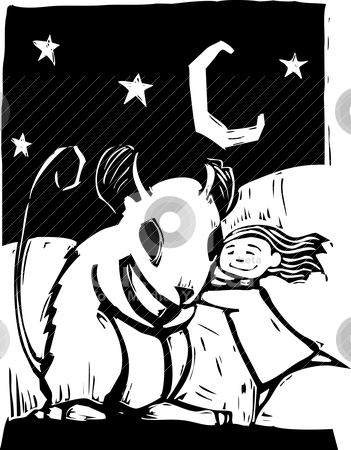
a linoleum print by Farangis G. Yegane

Could be a u-turn

Could be a u-turn (back to a more meaningful future)

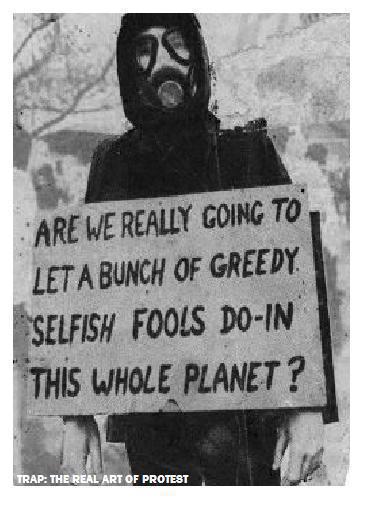
RIOTS on the streets are just one visible tip of an iceberg that “the establishment” is gonna hit … . Riots within society in peoples thinking and actions and in their feelings are really what we get aware of now – again, after years of a yuppie-style annihilation of a democratic culture, and this annihilation was brought about by a full commercialisation of any cultural once fruitful soil.

First a problem is being created, then the problem escalates, but who are you gonna blame?

– Does the fault lie with people who follow the one-way type of system, where you only find meaning in life if you can consume? The politicised glorification of the buying power of people is going so far that now something like the ethical consumer is being praised as a civilisatory ideal even.

– Or does the fault lie with the sections of society who think up and manage the production and the merchandizing processes, (the elite workforces, the investors, the banks, the advisors, the advertisement companies)?

Which role does the media play as the huge digestive system between opportunity seeking businessmen and -women, manipulators and the receiving end made up of willing spenders?

Can political institutions and their long arms change something within a menace created by the self-strangling economical system that makes our societies clash from within its own innards?

The people finally won’t have much of a choice when they aren’t left with any place to breathe amongst a type of culture that only gives you space to make sense out of your life if you can afford to have it.

The profiteers have started a cold civil-war against the assumed losers of the societies. The real question will be however if we will be able to create new and different ways of thinking and acting up that will break the chains of the old establishments (our hierarchical human systems) in whichever disguises we even might face them?

NOTE: Things have gotten out of balance when the intent became the real problem.